
"Coded" De-Coded (no. 3): What worldview makes shattering the Star of David seem ethical?
A Toolkit Series | The central failure in antisemitism prevention is interpretive | A public interpretive toolkit for recognizing how antisemitic logic mutates and disguises itself as moral.

“Coded” De-Coded: How Lefty Antisemitism Works is a multi-issue public interpretive toolkit examining how antisemitic ideas mutate, disguise themselves, and become morally legible within contemporary activist, academic, and institutional language.
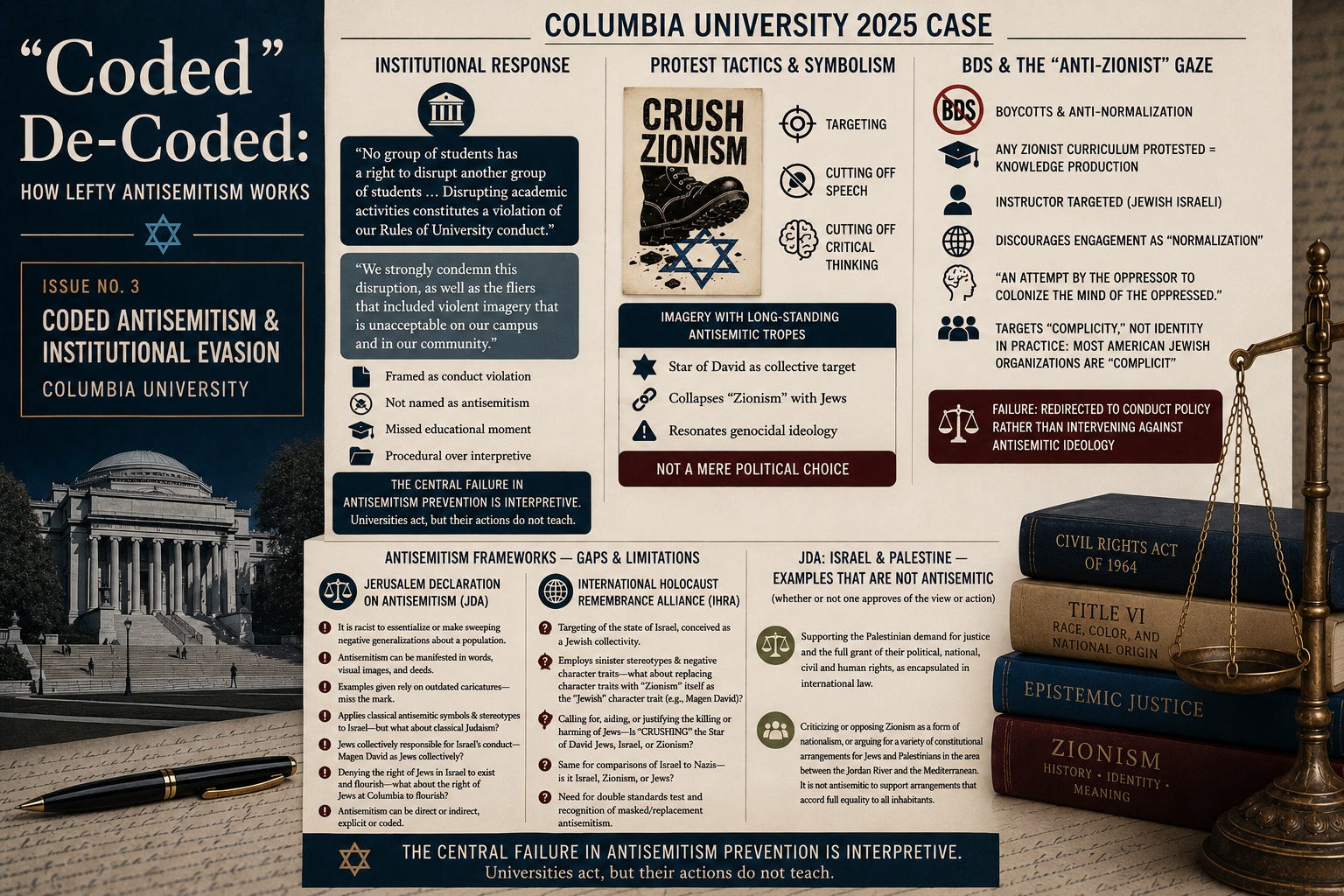
This week’s issue of “Coded” De-Coded analyzes a case study out of Columbia University.
A classroom disruption on the first day of “History of Modern Israel”
A protest flyer with the words “CRUSH ZIONISM,” depicting a military boot stomping out the Star of David
and Columbia University’s response — which couldn’t even call these incidents antisemitic.
If your immediate reaction to that list is, preemptively, "yeah … that sounds like antisemitism," the most important question still remains:
Can you explain why?
This is where the real interpretive work begins.
The Central Failure in Antisemitism Prevention is Interpretive.
During winter semester in 2025, a group of antizionist protesters disrupted the first day of “History of Modern Israel” at Columbia University. The school’s Interim President responded to the antizionist protest:
“No group of students has a right to disrupt another group of students … Disrupting academic activities constitutes a violation of our Rules of University conduct.”
Columbia University did not say that targeting this specific course or its Jewish/Israeli faculty member was antisemitic. The institution did not say that distributing flyers while doing so that depicted a combat boot stomping out the Star of David and the words “CRUSH ZIONISM” was antisemitic.
Instead, the Interim President suggested that perhaps:
“… the nature of the disruption may constitute violations of other University policies … We will move quickly to investigate and address this act … any act of antisemitism, or other form of discrimination, harassment, or intimidation against members of our community is unacceptable ...”
In other words, if this is antisemitism, like “other forms of discrimination,” that would be “unacceptable.” And even if this is antisemitism, the act of disruption is against our University “conduct” rules — so we will not “tolerate” the act itself. But if this is antisemitism is not the main issue. We are concerned with a conduct violation.
Let me explain why that’s a cop-out.
In Columbia’s statement, the school did not address the mechanisms, target, imagery, or effect as antisemitic explicitly. Instead:
“We strongly condemn this disruption, as well as the fliers that included violent imagery.”

… “Violent imagery?”
By not immediately determining the flyer’s content to be antisemitic, Columbia University avoided their duty — as an institution of learning — to educate.
This evasion is abysmal, but it is not abnormal. University initiatives to “combat antisemitism” frequently stay inside bureaucratic tasks and procedural management — where administrators can enforce university rules against disruptions (i.e., “conduct,” incidents) but do not have to coherently determine if/that antisemitism occurred. In lieu of conceptual clarity, procedural management avoids pedagogical tasks.
Universities act, but their actions do not teach.
Okay, but … Was the Flyer Antisemitic?
The poster shows a darkly shaded military combat boot, which attracts most of the visual space in the flyer, shattering a Star of David that is intertwined through the phrase, “CRUSH ZIONISM.” This imagery conveys a Jewish collective target for subjugation — not a political one. It implies aggressive violence and the elimination of a specifically Jewish target.
However, to defend this determination unequivocally, we need to be able to coherently explain:
the history of using the Magen David (Star of David) as symbol for Jewish peoplehood
the interrelationship between internal adaptation, racial antisemitism, and the history of Zionism, and
prominent forms of classical antisemitic tropes themselves.
Is the Star of David a Symbol of Jews?
or a symbol of Israel? …
… or a symbol of both?
The Magen David, which appears on the national flag of Israel, was neither invented by Zionism or the State of Israel, nor is it an exclusive symbol of modern Jewish sovereignty.

The Israeli flag was designed to allude to a tallit, the Jewish prayer shawl. The white background with two blue, horizonal lines look and feel like that ancient ritual object.
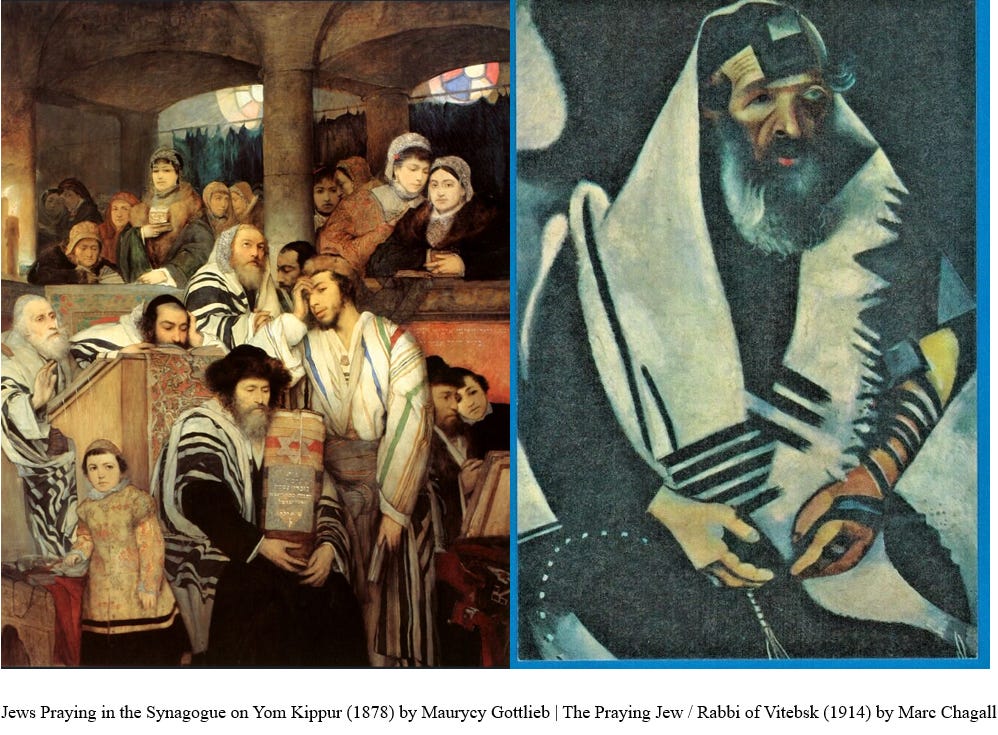
The part of the flag reminiscent of a tallit was purposeful, tied to Judaic ritual custom and indigenous inheritance.
The Magen David in the middle of the Israeli national flag is inspired by a distinct Jewish object — an added layer. The geometric motif has origins as a magical amulet in the ancient Middle East. The term Magen David literally translates to “Shield of David.” It is poetically used in early religious texts to describe God’s protection, and the 17th century marks its evolution into a universal symbol of Judaism.
I will not cover here the history or intentions behind designing the flag of the State of Israel, but I will explore the meaning and use of the Magen David as a symbol through one specific case study.
In a 1977 American Reform Responsa, the Central Conference of American Rabbis (CCAR) was asked:
“Should an Israeli flag be displayed on the pulpit of an American Reform synagogue? In this case, an American flag is already so displayed.”
Responsa are written legal interpretations and discussion dedicated to answering specific cases, problems, and/or contemporary questions. After the final redaction of the Talmud (c. ~500 CE), these function like case law — formal responses to contemporary questions in Jewish life, based on precedent in Jewish law.
The CCAR answered:
“The six-pointed Star of David is now commonly recognized as a symbol of Jews and Judaism throughout the world, both by ourselves and by our non-Jewish neighbors. There is no clear distinction between Jews and Judaism, between our religious and our national aspirations.”
The CCAR also determined that the widespread use of the Magen David as a symbol for Jewish collectivity is a modern phenomenon, dated to the late 18th and early 19th century, but that it appeared in early Jewish communities, too. Modern political Zionism was founded in 1897, almost a century after that range. The State of Israel — whose flag is in question — was founded in 1947, roughly 1.5 centuries after that range.
According to the CCAR:
“The six-pointed star now so commonly used was rarely used as a Jewish symbol before the late 18th century and early l9th century.”
But it was not absent.
As early as the third century, “it is found carved on a stone in the Capernaum synagogue … on a single tombstone … [and later] in some non-Kabbalistic medieval manuscripts. None of these usages, however, was widespread.”
The CCAR situates the uptake of the Magen David as a widespread symbol of Jewish collectively by the late 18th/early 19th century alongside both internal and external trends.
INTERNALLY
“… the newly emancipated Jewish community [in Europe] wished to possess an easily recognizable symbol akin to that of Christianity and so adopted the six-pointed star, which was then used frequently on books, synagogues, cemeteries, tombstones, etc. The star soon became recognized as a sign of Judaism …”
… In 1822, the Rothschilds utilized it for their coat of arms, and it was adopted by the Zionist Congress in Basel in 1897 as its symbol….
… Subsequently, the State of Israel has used it in its national flag,
although the official symbol of Israel is the menora.”
[Emphasis added]
EXTERNALLY
“In 1799 [the Star of David] was already used in anti-Semitic literature …
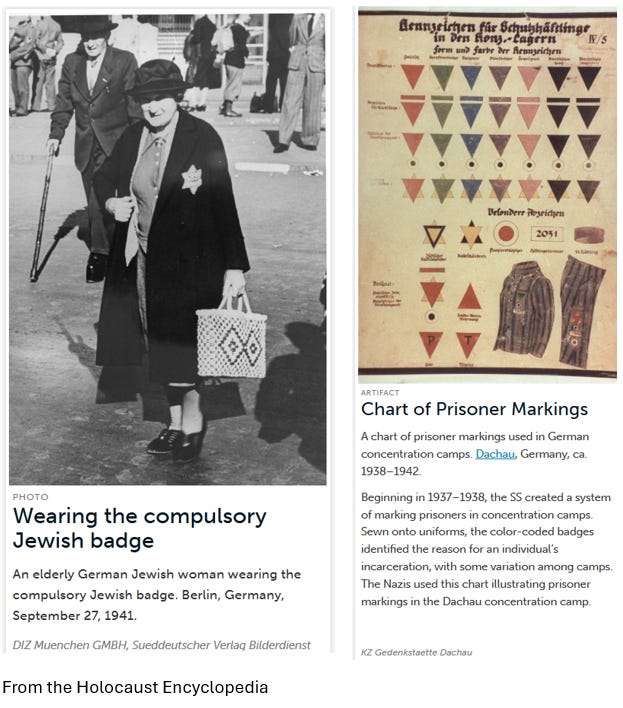
… Naturally, all of us also remember that the Nazis used the six-pointed star on their badges which identified Jews.” [Historical context note: The Nazi regime began in 1933.]
To understand what “the newly emancipated Jewish community wishes to possess,” we need to understand that Jewish emancipation is distinct from how “emancipation” is spoken about in the US context (e.g., enslavement).
Jewish emancipation was not a single event, but a gradual, century-long process of gaining civil rights, legal equality, and citizenship. For nearly 1,500 years, deeply entrenched economic, social, and cultural exclusions governed every facet of European Jewish life. These exclusions included:
legal disabilities,
barring Jews from guilds & trade,
prohibiting land ownership,
forced moneylending,
restrictions on family & marriage,
requiring of Jews special oaths in legal disputes,
linguistic and religious censorship,
cultural branding (e.g., the “Jewish badge” mandated by the 4th Lutheran Council in 1215),
various forms of social exclusion,
and physical persecution, including state-sponsored violence.
Exclusion was a pervasive social reality that isolated European Jewish communities for millennia before “Jewish emancipation” began. As strangers in strange lands, Jewish communities who lived for generations in the region were still considered alien and foreign — not equal citizens, on the very basis of because they were Jews.
“Jewish emancipation” was a process. It aimed to eliminate these centuries-long legal, civil, and political disabilities. Eventually, it abolished discriminatory laws (like mandatory ghetto residence and special taxes) and granted Jews equal citizenship and individual rights.
In 1791, following the French Revolution, France became the first Christian nation to grant Jews full, unconditional citizenship — a revolutionary act. By 1871, Jewish emancipation was finalized across the newly united German Empire.
Yet, in less than a decade from the moment German Jews finally achieved emancipation — fill, unconditional citizenship — Wilhelm Marr coined the term “Antisemitismus” (1879) and racial antisemitism rose to prominence. Whereas the historic, or “classical” anti-Judaism of Christian Europe persecuted and excluded Jews as a religious group — the “sinner who killed the messiah” — antisemitism determined the now-emancipated German Jews to be a genetically inferior, tainted race. As emancipation finally resolved anti-Judaism’s barriers to civic inclusion, racial antisemitism made Jewishness a born essence — Jews, even emancipated, could not be equal citizens on the very basis of because they were Jews.
This context helps us articulate the first two reasons why the use of the Star of David on the protest-flyer is antisemitic.
(1) The adoption of the Magen David as a symbol of the Jewish collective happened both internally and externally AT THE SAME MOMENT.
This is not a historical anachronism. Across history, Jews have interpreted and reinterpreted identity and character both in response to external categories and informed by intracommunal self-understanding and heritage texts.
One example is the Biblical Hebrew word, “Am.” In the Torah, this term refers to both a “people” and a “nation,” even “citizen.” Yet, not in a way that Jewish emancipation defined these terms. First and foremost, in the Biblical period, there were no modern “nation-states.”
In Jewish thought, “Am” is imagined through identity, collective experience, and peoplehood. Diaspora produced a “world Jewry,” and each community has been shaped by external forces while reconciling those forces through internal imagination.
The Star of David came to represent that Jewish collective peoplehood, that essence of world Jewry as a shared, sacred, family.
It also became used — from antisemitic literature to the Nazi “Juden” badges — to denote members of that Jewish collective family.
(2) The MENORAH with olive branches is the “official symbol” of the State of Israel, NOT the Star of David.

The flyer does not “CRUSH” a menorah with olive branches. Olive branches. Which of course derive from biblical symbolism of peace, redemption, and continuity. The poster does not stomp out the official Emblem of the State of Israel.
Instead, it stomps out a symbol of Jewish peoplehood — as a group, a community, a collective. Not a country. Not a political entity. The poster’s imagery crushes the symbol that is carved onto a Jewish tombstone from the third century, featured in Jewish family coats of arms from the 18th century, on synagogue exterior walls today, inside community spaces, and often dangling as jewelry on the very the necks of the Jewish people it represents.
The militant boot — which, artistically, functions as the eye-catching center of the poster — dominates over and onto Jewish people visually, militantly, and rhetorically. The connotations align directly with anti-Jewish, destructive intent. And genocidal ideology is not foreign to Jewish memory.
The protest-poster is therefore not a ‘mere’ political choice. It is illegitimate political speech. The objects are not ambiguous.
Do The “Definitions of Antisemitism” Explain Any of This?
anti-Jewish targeting … targeting Jews without saying “Jew”?
proceduralism vs. interpretation?
knowledge production and legibility of “coded” tropes … while collapsing Jews, Israel, and Zionism?
symbolic violence through imagination and imagery … and the failure of educational institutions to educate?
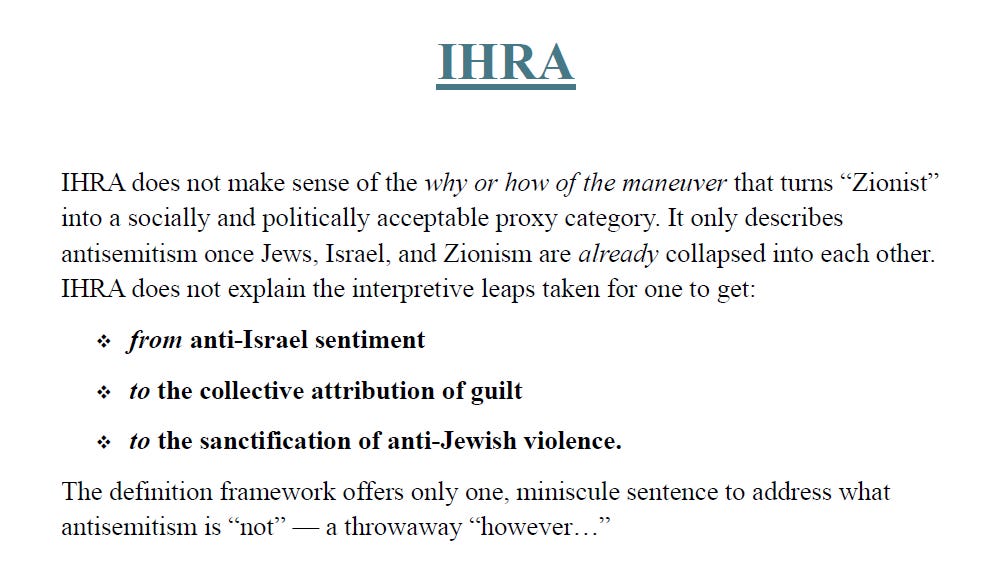
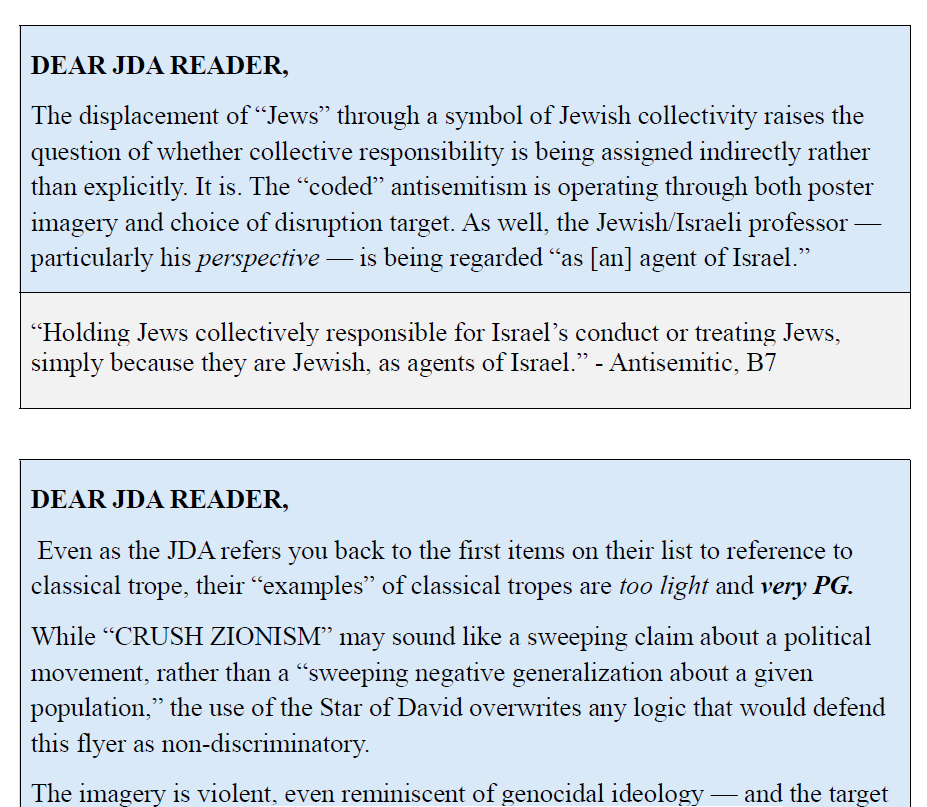
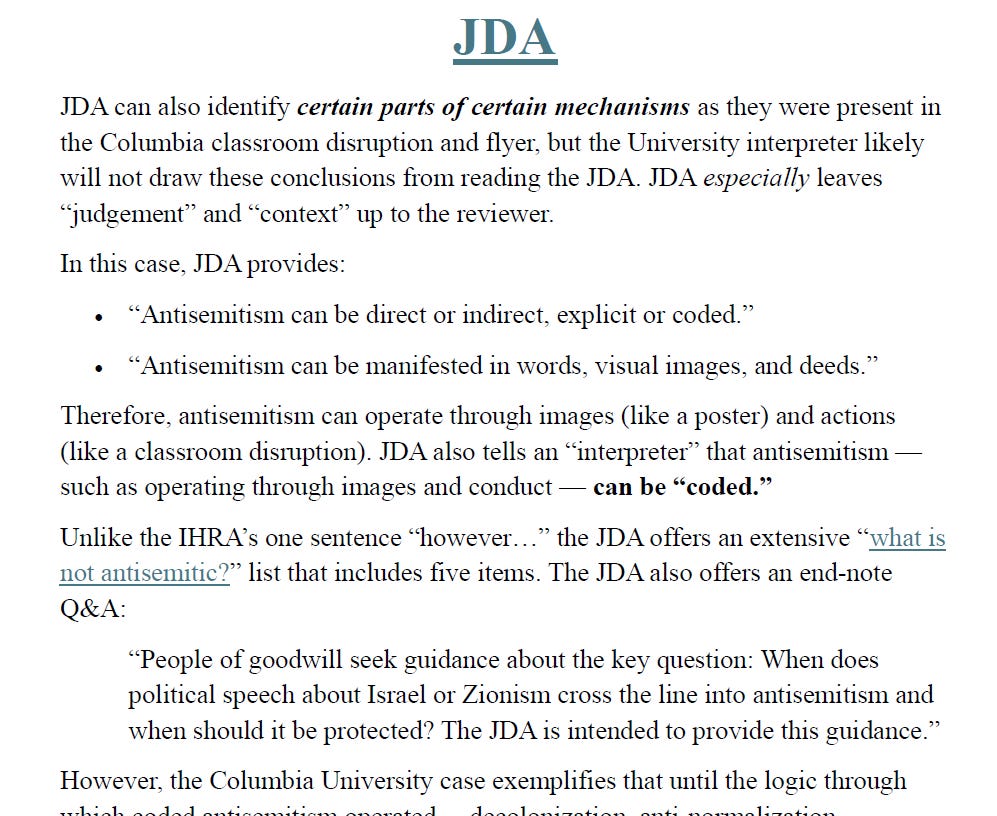
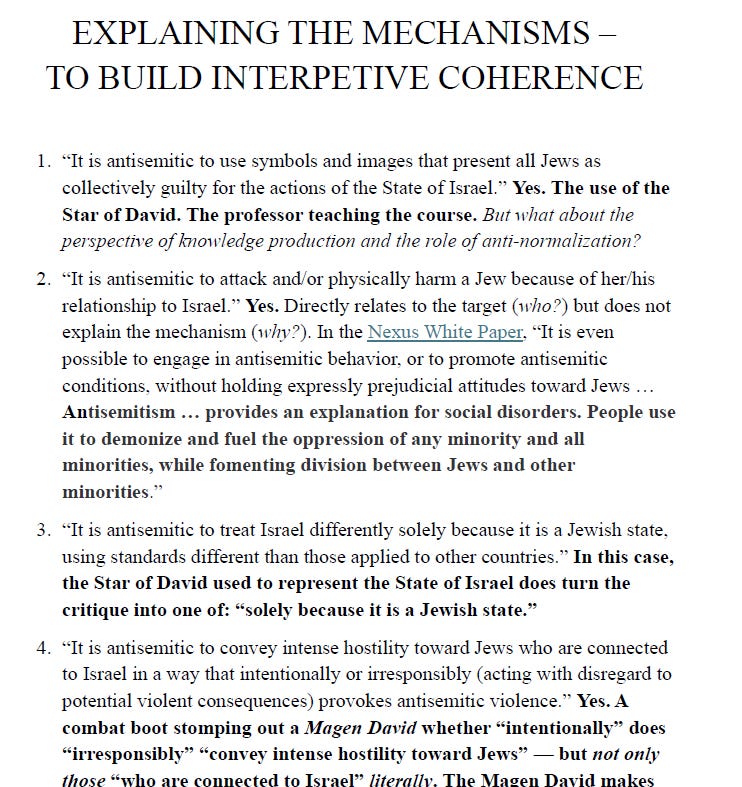
The answer is: partially. All three definitions identify pieces of what occurred at Columbia, but none explains the interpretive mechanics that made the features of the incident appear moral, justified, or politically necessary in the first place.
Rather than interrupt the flow of this case study, I have placed separate companion resources below that walk through IHRA, JDA, and Nexus point-by-point, showing where each framework helps, where each remains ambiguous, and which questions the definitions still leave unresolved.

THE TARGET
BDS & the “Antizionist” Gaze
The problem is not that Columbia failed to punish a disruption — it is that they did not adequately explain what the disruption meant.
If Columbia students wanted to protest Israel, there were hundreds of possible targets. Instead, protesters disrupted a course called History of Modern Israel taught by a Jewish/Israeli professor. Why?
Why this class? Why this professor?
To answer those questions, we need look beyond the flyer and start looking at the worldview that made the disruption appear justified.
That worldview is often called anti-normalization.
We need three concepts to explain that antizionist-BDS activists view engagement with Zionist perspectives not as bridge-building, and not as learning encounters, but as participation in oppression. These are:
1. Anti-normalization
2. Knowledge production
3. Decolonization
Imagine a student who believes:
Zionism is a settler colonial project
settler colonial projects are illegitimate
settler colonialism is an ongoing process, not an isolated event
normalization legitimizes illegitimate systems
normalization enables the process to keep going.
Under this logic, Columbia allowing a course on Israel to be taught by a Zionist professor is not education. It is collaboration. It is complicity.
Once this perspective shift occurs, disruption and protest appear politically legitimate and morally necessary.
BDS rejects “an attempt by the oppressor to colonize the mind of the oppressed.”
Boycott, Divestment, and Sanctions movement (BDS) establishes “Anti-Normalization Guidelines” to “resist oppression, its mechanisms and structures.”
“What anti-normalization principles reject are attempts to represent Israel alongside Arab countries as if it were a normal part of the region, not a settler-colonial and apartheid state … Countering normalization … ensures that such joint activities are not used to normalize oppression …”
FOR EXAMPLE …
from my own time in BDS
Restricting or villainizing travel to Israel because it condones Zionism “as if [Israel] were a normal part of the region, not a settler-colonial and apartheid state” [BDS]. Through participation, tourism economically supports Israeli/Zionist institutions, engages in Israeli culture, and lends legitimacy to Zionist ideas.
Boycotting American Jewish organizations because they, too, are Zionist — i.e., in their mission statements, financial ties, or Israel-related initiatives. This is the logic that makes campus Hillels, community Federations, synagogues, Jewish community centers, day schools, youth groups, summer camps, and literal institutions of learning legitimate targets as conspirators — Zionist entities.
Determining that engagement with Zionist narratives, individuals, or organizations are acts of “normalization.” This leads to the determination that teaching or taking a History of Modern Israel course taught by a Jewish/Israel professor is an intellectual, cultural, and pollical act of crossing the picket line. Under the logic of anti-normalization, calling for, planning, and carrying out a classroom disruption becomes legitimate, just, and politically necessary.
According to BDS, the movement “does not call for or condone boycotts of individuals because of their Israeli or Jewish origin or identity … BDS targets complicity, not identity.” However, through academic, cultural, and economic boycotts, BDS logic, in practice, heavily restricts or outright prohibits engagement with “Zionists.”
Because open engagement with the alternative (Zionist ideas) is merely “an attempt by the oppressor to colonize the mind,” anti-normalization incapacitates the development of cross-cultural sensitivity, critical thinking capacity, historical complexity, or productive campus engagement.
Was the classroom disruption really legitimate political speech? Or was it an act of injustice? The target was Jewish. The story was Jewish.
Just because BDS calls for anti-normalization as an act of reparative justice does not make all acts of anti-normalization just.
Through BDS anti-normalization logic, Zionist narratives are treated as dominant, oppressive, and inherently violent.
Anti-Zionist Jews
I call Zionist narratives “Jewish” not because Zionism is the only, primary, or “right” way to practice or identify with one’s Judaism. In this sense, Jewish anti-Zionists identities are not un-Jewish.
Rather, Zionism arose from and through ideas, customs, yearnings, intellectual traditions, and imaginations very particular to Jewish experiences. While the mechanisms of Zionist consciousness were informed by rising national consciousness movements broadly in the 18th and 19th centuries, Jewish national consciousness throughout diaspora sits in its own category. Return to Zion as a Jewish idea means that understanding the nuances of modern Zionism cannot be separated from the particularity of Jewish history as Jewish.
From my experience, Jewish anti-Zionists in the anti-normalizations and decolonization tradition must agree that Zionist narratives are oppressive, dominant, and violent. Doing so removes the Jewish essence of the history of Zionism — replacing it with universalized historical revisionism. Even though there are Jews who object to the end point of political Zionism (Jewish political sovereignty in the state of Israel), that does not make Zionist ideas themselves distinct from Jewish inheritance. See “The (Anti)Zionist Litmus Test” diagram in Issue no. 1.
JEWS & THE EVIL “WEST”
Holocaust Memory & Knowledge Production
As noted in the first issue of “Coded” De-Coded, the conspiratorial attribution of “knowledge production” power to Jews, ironically, is very much tied into interpreting Holocaust memory.
At first glance, Holocaust memory seems unrelated to a classroom disruption.
But many anti-normalization arguments depend upon a deeper claim: that Jewish narratives of vulnerability are exaggerated, politically instrumentalized, or used to obscure Palestinian suffering. That Holocaust memory itself represents “Jewish privilege” vis-a-vis other marginalized communities. To understand the Columbia case fully, we have to examine that assumption.
The Holocaust is narrated as part of a Eurocentric story (“it happened in Europe”). Recall Whoopi Goldberg’s 2022 statements on The View:
“… let’s be truthful about it because the Holocaust isn’t about race. No, it’s not about race … this is white people doing it to white people … these are two white groups of people.”
Nazism and racial antisemitism specifically excluded, persecuted, and murdered Jews as an ‘inferior’ race that was tainting German society. Yet, Goldberg’s statements assume that, because the Holocaust happened in Europe, everyone was white (e.g., “white people doing it to white people”). She assigned contemporary American racial constructions onto an entire continent.
Many scholars make a similar argument, too. Alexander Weheliye in Habeas Viscus (2014) critiques what he perceives as Eurocentric hierarchies of remembrance. He argues that the Holocaust is treated as the “apex in the telos of modern racializing assemblages.” Calling this Holocaust exemplariness, he argues that atrocities committed by Europeans beyond the continent of Europe — “all interpretations...not immediately tied to Nazism…” — become seen as “crude, simplistic, prehistoric, and undeserving of sustained critical attention.”
In the context of antizionism and anti-normalization, “Holocaust exemplariness,” or
The relatively hierarchical position of the event Holocaust in the ‘canon’ of Western memory — is reinterpreted as a sign that Jews have narrative privilege that other groups do not have.
Because the critique of Holocaust exemplariness is that “the West” acknowledges the Holocaust as an atrocity in a way it does not or will not do for other genocidal histories:
the institution of slavery
Indigenous erasure, displacement, and land left under colonialism
the ongoing violence of settler colonial regimes.
THE PROBLEMS WITH THIS LOGIC
Protesting the dominance of Holocaust memory as a “Eurocentric story” — and identifying an apparent Jewish “privilege” because of the prominence of the Holocaust in our memory — is a susceptible to repackaging classical antisemitic tropes.
The Holocaust did not “only” happen in Europe.
While the Holocaust is primarily remembered as a European tragedy, the Nazi genocide’s reach and impact extended beyond one continent. The systematic persecution, forced labor, and murder of Jewish people —alongside other Nazi victims — were felt in North Africa, especially, and internationally through colonial networks, refugee crises, Vichy race laws, forced labor camps, and deportations.
It is legitimate to argue that it “feels like” the Holocaust has been integrated into Western collective memory and is treated with greater seriousness than atrocities committed by Western empires against other groups. It is not legitimate to claim that the canonization of Holocaust memory proves Jews are white, powerful, or no longer victims of oppressive systems.
Manipulating the genocide of six million Jews into a story about the apparent evidence of Jews controlling or having power in Western “knowledge production” presents a direct line into “classical” antisemitic tropes:
Sanctification of Anti-Jewish Violence (Lethal) is a justificatory logic that depicts Jews as enemies who death and destruction advances a sacred, revolutionary, or utopian cause. Morally necessary, divinely ordained, or historically redemptive. Destruction is collective and total.
Conspiracy Myth (The Organizing Logic / Fantasy) assigns Jews disproportionate agency over systems and frames them as responsible for “why things go wrong,” thereby licensing hostility and exclusion under the guise of accountability. See “IHRA Decoded: An Educational Tool” to read further.
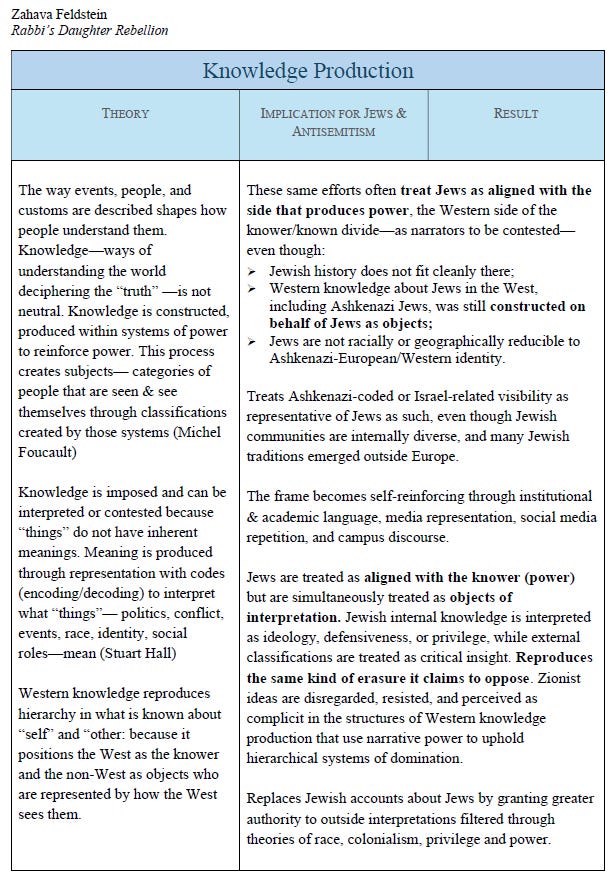
The Columbia disruptors targeted the “History of Modern Israel Course” because — taught by a Jewish Israeli instructor — the perspective of a “Zionist” was determined to be inherently one of an oppressive actor who controlled the narrative. Thereby enacting violence against Palestinians. The underlying logic is that any course taught from a Zionist perspective is part of dominant, oppressive, Western canon production.
Anti-normalization, decolonization, critical consciousness, and knowledge production are all related frameworks.
KNOWLEDGE PRODUCTION is a concept that has deep roots in postcolonial theory. Understanding it is core logic helps make sense of BDS’s “anti-normalization” campaign in academia and what happened at Columbia. What did the University respond versus what mechanisms of antisemitism occurred?
Decolonial frameworks are not inherently antisemitic, nor do all scholars or activists who employ decolonial analysis advocate for the elimination of Jews or the destruction of Jewish collective life.
Decolonial scholarship about knowledge production emerged from historically grounded critiques of empire, extraction, racial hierarchy, and political domination. It offers important analytic tools for understanding the legacies of colonial violence across many contexts.
The concern here is narrower and more specific.
Decolonial logic becomes antisemitic when it dismisses the possibility that Jews might legitimately require collective defense at all — and it refutes that possibility by discrediting Jewish testimony and prohibiting engagement with Zionist ideas (“anti-normalization”).
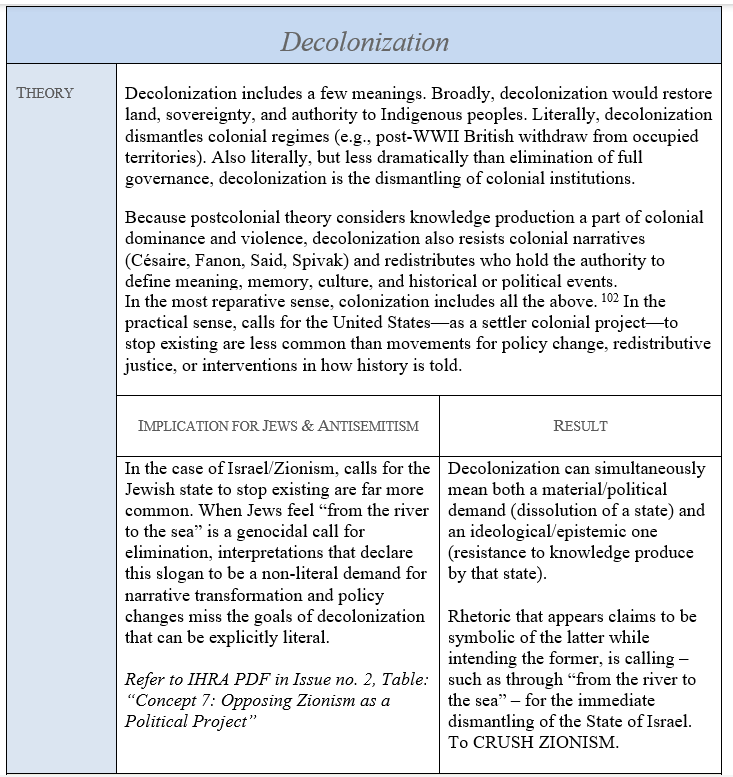
BDS logic does not merely oppose Israeli policy or “Zionism as a national project.”
The logical endpoint of BDS, in practice, is an indifference to the possibility that Jewish collective security might matter. Or even outright rejection.
And “anti-normalization” prohibits engagement with the Zionist stories, narrators, places, or perspectives that would help people understand why Jewish collective security matters at all.
This means that BDS “anti-normalization” leads to a lack of awareness, a lack of “Jewish cultural and historical literacy.”
That lack of awareness creates ample opportunity for antizionists to uptake classical antisemitic ideas — in repackaged, social justice language.
When Columbia University responded to “conduct policy” and “University rules” violations rather than antisemitic ideology, they evaded their educational obligation as an institution of higher learning to teach.
The Jerusalem Declaration on Antisemitism contends that
“Supporting the Palestinian demand for justice and the full grant of their political, national, civil and human rights, as encapsulated in international law” is not antisemitic. “Criticizing or opposing Zionism as a form of nationalism, or arguing for a variety of constitutional arrangements for Jews and Palestinians in the area between the Jordan River and the Mediterranean … is not antisemitic.”
That can still be true.
But disrupting this History of Modern Israel classroom was antisemitic — not because the activist-protestors “support[ed] the Palestinian demand for … the full grant of their political, national, civil, and human rights.” Not because the disruptors “oppos[ed] Zionism as a form of nationalism.” It was antisemitic because the tactics:
operated through an exclusionary logic that prematurely discredited Zionist perspectives,
targeted the individual instructor as a “Zionist” interlocutor, and
refused the same “full grant of” to the expansiveness of Jewish knowledge and interpretive agency.
What happened at Columbia was never just a university rules violation or a classroom disruption. From the target to the imagery to the enactment, this case study tested whether an institution would or could explain the mechanisms behind the minds of antizionism.
Rules can address disruptions. Definitions can give examples of antisemitism. Neither can explain why this occurred or could pass as moral, just, and legitimate.
Combatting antisemitism requires interpretation. And interpretation requires historical literacy, cross-cultural dialogue, and the normalization of new tools — expressly prohibited under anti-normalization.
Combatting antisemitism also takes chutzpah — to ask hard questions and grow your interpretive “toolkit.” Especially when educators themselves do not want to hear it, or do not know how to answer.
Until you can see the mechanisms of “coded” antisemitism:
decolonization
anti-normalization
knowledge production
the revisionism of who has “privilege” …
The “I combatted antisemitism” checklist remains far too slim. Combating antisemitism is not a checklist. It is a praxis. It happens on the level of literacy and ideology — precisely the educational task Columbia University avoided.
Some say that within each of us, there is an element of all of the four children from the Passover seder — we can all be evil, we can all believe someone else’s plight has nothing to do with us. We all are wise to our own epistemologies — the ways we each make meaning out of and through the world.
Between the wise child, the wicked, the simple, and the one who does not yet know how to ask, which one would you like to be?
Ambivalence — “we’re looking into it” — does not educate.
It is the worst of each of the four children. If nothing else, let us learn how to ask.
Next week, “Coded” De-Coded will move into a new case study. This series examines how coded antisemitism operates: through protest slogans, institutional statements, classroom discourse, activist rhetoric, and campus controversies — specifically cases where antisemitic structures are articulated through the moral vocabularies of justice, anti-racism, decolonization, and collective liberation.
See Issue no. 1, “Coded” De-Coded: How Lefty Antisemitism Works - Title VI”
See the “IHRA Decoded Education Tool,” an 18-page PDF resource for translating IHRA’s 11 examples in real-life situations.
See Issue no. 2, “IHRA, JDA, Nexus - What’s the Difference? What’s the Point?”
OPTIONAL ENRICHMENT
When I taught the 1997 CCAR Responsa, I paired it with the Pittsburg Platform (1885) to put the American Reform Judaism progression from anti-Zionism to Zionism side-by-side. The Pittsburgh Platform is the founding Document of the American Reform Movement - Pittsburgh Platform. Accompanied by annotations and guiding questions for learners and facilitators.
CORE CLAIMS of Pittsburgh Platform: (1) “We maintain” monotheism. (2) Evolution (”modern discoveries in scientific researches”) can coexist with Judaism. (3) Maintain mitzvot and a “system of training” without “national life in Palestine” that is ... not adapted to the views and habits of modern civilization” (e.g., no dream to rebuild the Temple). (4) Observing kashrut, Shabbat, “priestly purity and dress” are “foreign to our present ... state” and do not need to be observed. (5) ANTI-ZIONIST: “We consider ourselves no longer a nation, but a religious community, and therefore expect neither a return to Palestine, nor...” (6) Interfaith/ecumenical brotherhood and “fellowship” (7) Rejection of Heaven/Hell vis-a-vis sin & punishment (8) SOCIAL JUSTICE: “we deem it our duty to participate in the great task of modern times, to solve, on the basis of justice and righteousness, the problems presented by the contrast and evils of the present organization of society.”
The Columbus Platform (1937) would also be a great addition to this lesson.
The actual poster origin — aka where Columbia protestors retrieved it from — is uncertain, However, the image includes a byline of “Palestine Liberation Poster Project.” [Translated from Spanish: “The Palestine Liberation Poster Project, created by THE()PALICLUBoY, aims to promote awareness about the struggle for Palestinian freedom through artistic posters. The project combines art and activism to convey political and social messages. The initiative seeks to engage the public and foster discussions about the situation in Palestine.]
🤣🤣🤣
Take your death star hasbara garbage and fuck off, genocide apologist.