
"Coded" De-Coded: How Lefty Antisemitism Works (no. 2)
A Toolkit Series | IHRA, JDA, Nexus - What's the Difference? What's the Point? | A public program for recognizing how antisemitic logic mutates, disguises itself, and becomes morally legible.

“Coded” De-Coded: How Lefty Antisemitism Works is a multi-issue public interpretive toolkit examining how antisemitic ideas mutate, disguise themselves, and become morally legible within contemporary activist, academic, and institutional language. Tune in for weekly examples unpacking the interpretive mechanics of contemporary antisemitism.
See Issue no. 1, “Coded” De-Coded: How Lefty Antisemitism Works - Title VI”
See the “IHRA Decoded Education Tool,” an 18-page PDF resource for translating IHRA’s 11 examples in real-life situations.
Welcome to the second issue of “Coded” De-Coded. This series breaks down how to identify moments when “classical” antisemitic logic is repackaged. As promised, this week I’ve compiled among the most compressive, comparative overviews of antisemitism definitions you will likely find — the IHRA, JDA, and Nexus.
This week’s issue is intended as a long-term resource guide. Save it. Download the PDFs. This is not a great-hook essay. It is a usable toolkit.
Debates over how to define antisemitism shape how students, faculty, lawmakers, and administrators talk, teach, protest, and respond to discriminatory activity. The International Holocaust Remembrance Alliance (IHRA, 2016) working definition of antisemitism dominates this landscape. As of early 2026, IHRA had been adopted by over 40 counties, governing bodies including the EU, hundreds of local governments, school districts and state education systems, and—increasingly—American colleges and universities.
The IHRA is routinely countered directly with the Jerusalem Declaration on Antisemitism (JDA, 2021). The JDA proposes that “opposing Zionism as a form of nationalism” as not inherently antisemitic.
Along with the Nexus Document (2021), these three sources jointly debate whether, when, and to what end anti-Israel speech is antisemitic. In legal terms, is it free speech or discriminatory speech? In Jewish terms, nu?
Rather than treating allegiance to any of one these definitions as slogans in a political fight, I map what they actually say, where they agree, where they diverge, and what each one helps readers see that the others do not. This series does not claim a stake in one definition. Instead, over the coming weeks, I aim to convince you that we need tools from all three definitions.
I argue that each of these three frameworks captures a real dimension of contemporary antisemitism on the left — especially campus antisemitism — but that no one definition independently describes the full machinery …
Especially not as I experienced it.
An Overview of Conflicting Definitions
IHRA, JDA, Nexus
I’ve landed on a reflexive position with these definitions — both academically and personally. As a graduate student facing daily antisemitic hostility, I found myself needing to pull examples from each of these definitions that the others did not provide. But even together they still do not fully give the words I needed to explain my experience. So why am I writing about them? Because, apparently, we’re still stuck on “what is antisemitism?” — and the definitional debate is detracting from sustained curiosity and interpretive literacy.
IHRA emphasizes legal legibility and civil-rights enforcement by treating Jews as a protected group with shared ethnic and national characteristics. IHRA says that opposing Zionism as a “racist endeavor” is antisemitic.
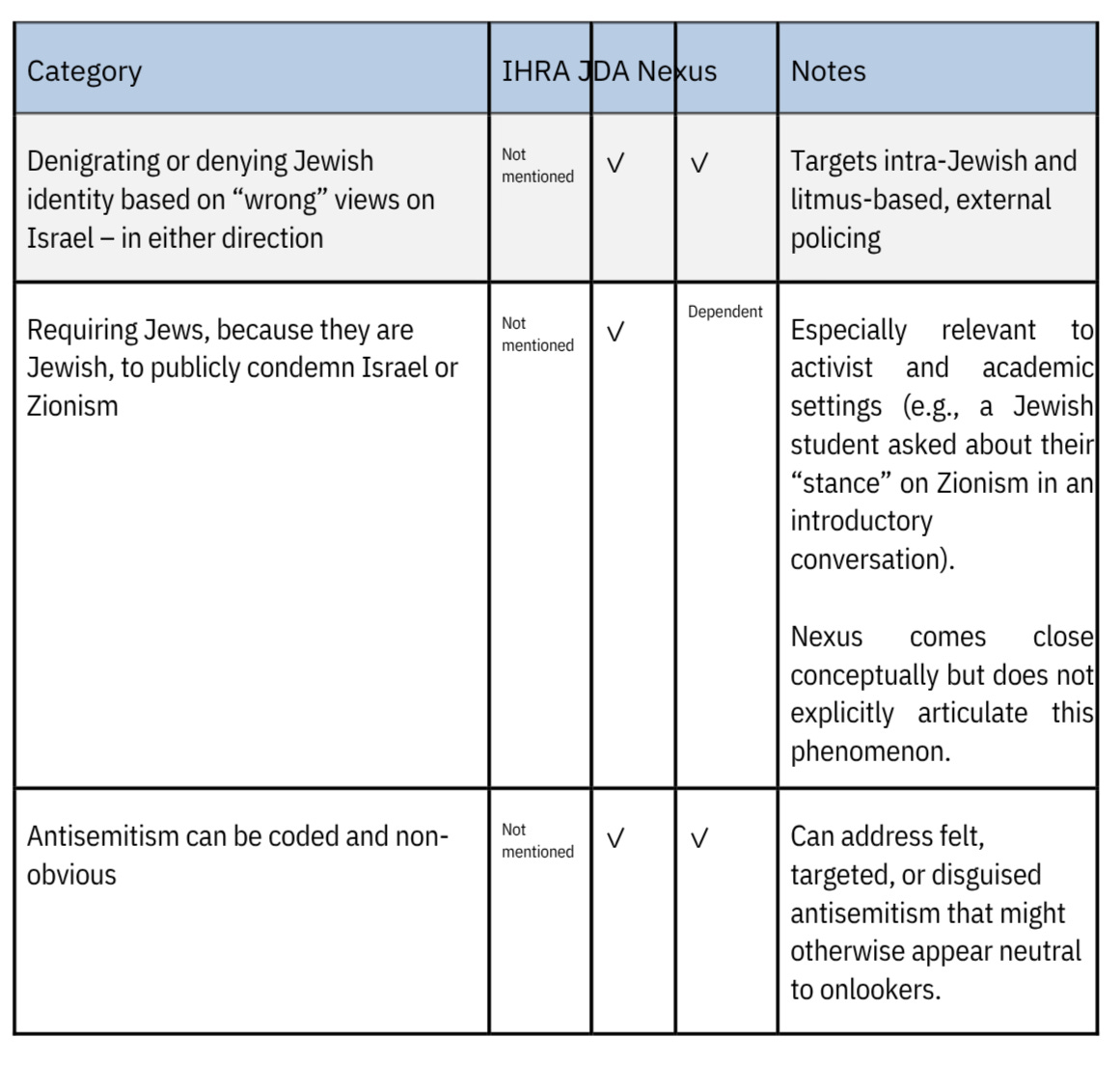
JDA says that “opposing Zionism as a form of nationalism” is not “inherently” antisemitic. JDA usefully identifies coercive demands that Jews publicly disavow Zionism (the “litmus test”) as antisemitic.
Nexus highlights antisemitism’s function as a structuring mechanism — a social code — for marginalized communities to redirect anger at system of power onto Jews as imagined agents of “oppression.”
(1) none of these definitions alone completely describes how coded antisemitism operates in activist-intellectual spaces.
(2) adoption of any definition does not also ensure the interpretive capacity to combat antisemitism.
Definitions are not neutral policy tools. They are interpretive frameworks, actively debated by people — invoked, resisted, used to establish or deny norms of respectful dissent. Administrators and lawmakers use them. However, people determine which grievances merit intervention versus which are a matter of “perception.” People interpret, not these definitions.
Where The Definitions Agree
“Classical Antisemitism”
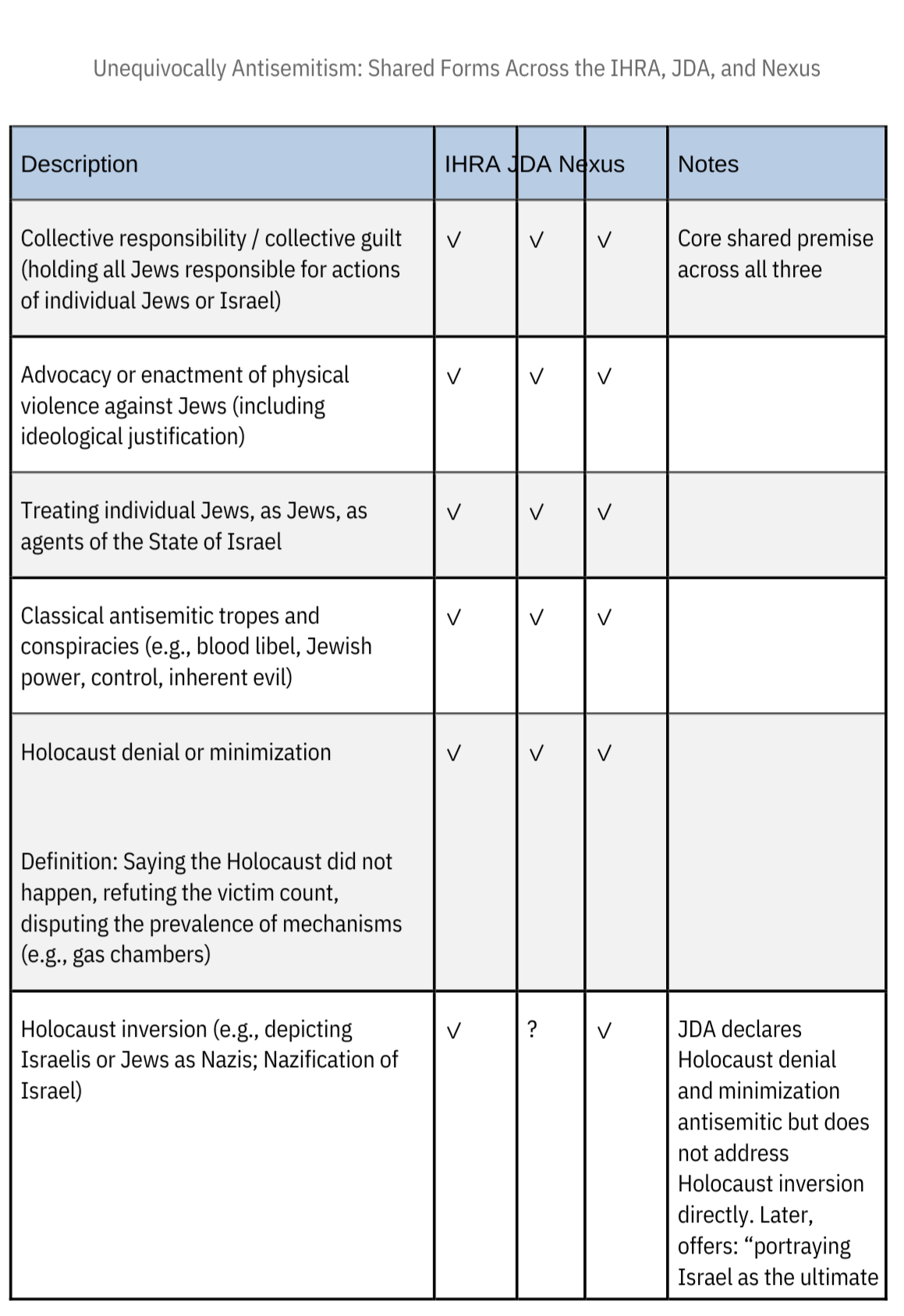
**"JDA continued: “…portraying Israel as the ultimate evil or grossly exaggerating its actual influence can be a coded way of racializing and stigmatizing Jews. In many cases, identifying coded speech is a matter of context and judgement.” (See JDA section further down in this issue)
Dual Loyal across all three, as well.
Where The Definitions Diverge
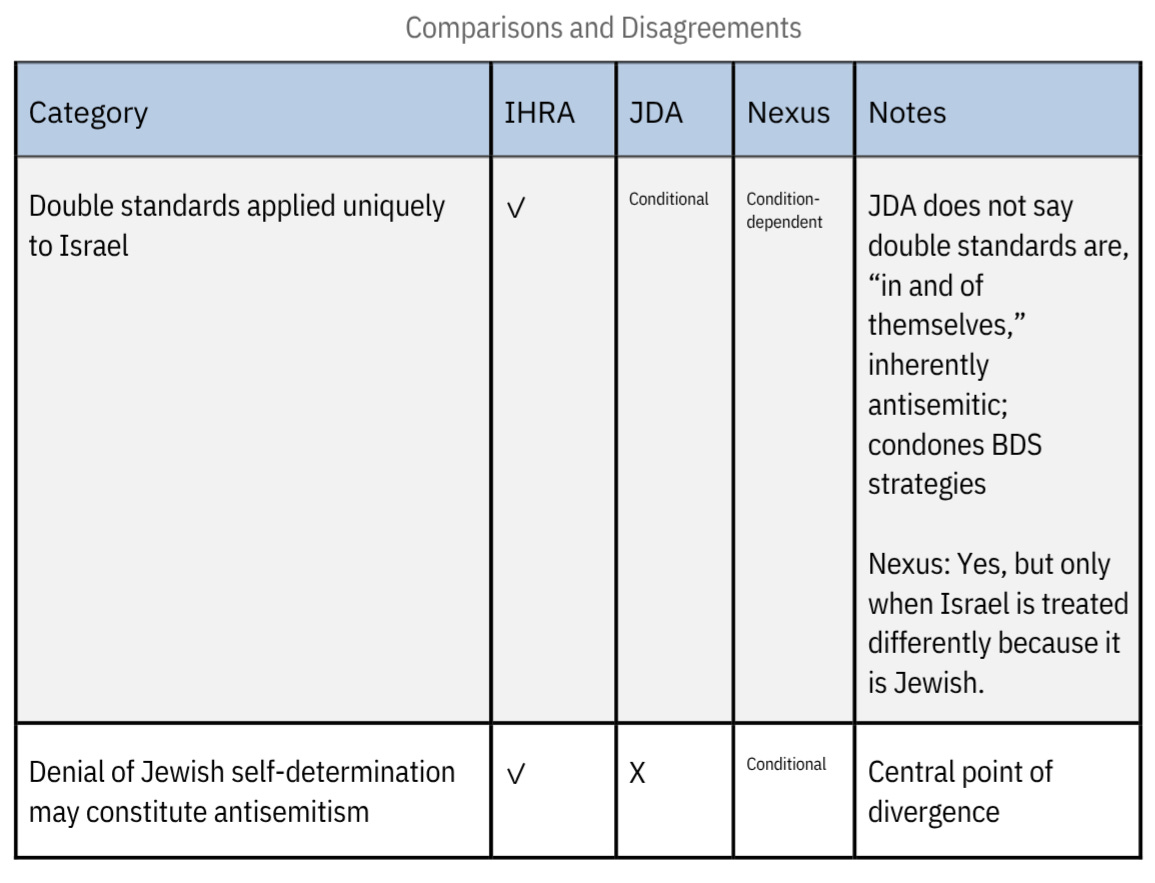
Contested Boundary on Zionism
IHRA asserts that calling the “existence” of the State of Israel a “racist endeavor” is antisemitic, effectively arguing that doing so is a strategy to “[deny] Jewish people their right to self-determination.”
JDA argues that critiquing the State of Israel or “opposing Zionism” using the frameworks of anti-racism—namely settler colonialism and apartheid—is not, “inherently,” antisemitic. Especially when these terms are employed to compare the State of Israel to “other historical cases.” On protest and disruption, political speech “does not have to be measured, proportional, tempered, or reasonable to be protected.”
Nexus emphasizes that Israel, “as an embodiment of collective Jewish organization” and self-determination, can become both a target and vehicle (“magnet”) for antisemitic expression. Nexus positions the assessment of intent around whether anti-Jewish discrimination functions through anti-Israel discourse, rather than around criticism of Israel itself. Nexus alone states that Jewish claimants should be taken seriously.
(1)
The IHRA Working Definition of Antisemitism
“Antisemitism is a certain perception of Jews, which may be expressed as hatred toward Jews. Rhetorical and physical manifestations of antisemitism are directed toward Jewish or non-Jewish individuals and/or their property, toward Jewish community institutions and religious facilities.”
The IHRA begins with this broad statement and then offers eleven examples to identify antisemitic content. The examples have been primary targets because most of them (seven out of eleven) relate to anti-Israel sentiment.
What IHRA is NOT
IHRA is not campus specific.
IHRA is not an educational tool; it is not pedagogy.
IHRA is not theory, paradigm, or praxis.
IHRA does not describe how antisemitism is produced, stabilized, or denied through institutional processes. Nor does it capture shaming rituals, loyalty tests, and interpretive conflicts through which Jewish complaints lose credibility long before legal standards come into play.
IHRA is a policy instrument.
It is insufficient as a comprehensive account of how antisemitism functions in practice; the history of antisemitism and anti-Jewish bigotry; or scholarly rigor. This is not to say it is wrong, but to directly clarify what it is not.
IHRA can be legally useful in the United States because it ostensibly makes Zionist forms of Jewish identity legible under Title VI law. The definition’s emphasis on Jewish peoplehood—expressed through ancestry, shared history, and collective self-determination—aligns with U.S. federal civil-rights law, which protects Jewish students under “national origin” or “shared ethnic characteristics” — not under “religion.”
Yet even if IHRA worked exactly as designed, it would still be subject to procedural routing, “contextual judgement,” and institutional interpretive incapacity. IHRA’s core claims — and communal inflexibility to maintain it — cannot account for the suspension of belief in Jewish testimony before adjudication even begins. As I discussed in the first issue of this series — in the StandWithUs vs. MIT case, IHRA’s logic failed because even when IHRA functions as a policy tool, those responsible for interpreting claims can still deny Jews standing as “credible knowers” of their own experiences.
The same IHRA examples that empower a Zionist to call an incident antisemitic enable an anti-Zionist to deny it.
The most common critique levelled at IHRA is the allegation that it cuts off free speech and legitimate political dissent, “particularly in regard to criticism of Israel.” Critics argue that adopting the definition compels self-censoring to avoid being accused of antisemitism. According to Palestine Legal, IHRA is a:
“Politicized redefinition of antisemitism designed to silence advocacy for Palestinian freedom.”
But according to the American Jewish Committee (AJC):
“Such critiques misrepresent [IHRA’s] purpose … foremost a flexible educational tool intended to help people recognize antisemitism — not sanction speech.”
But IHRA is not an educational tool. It is a policy tool. And those are two very different domains.
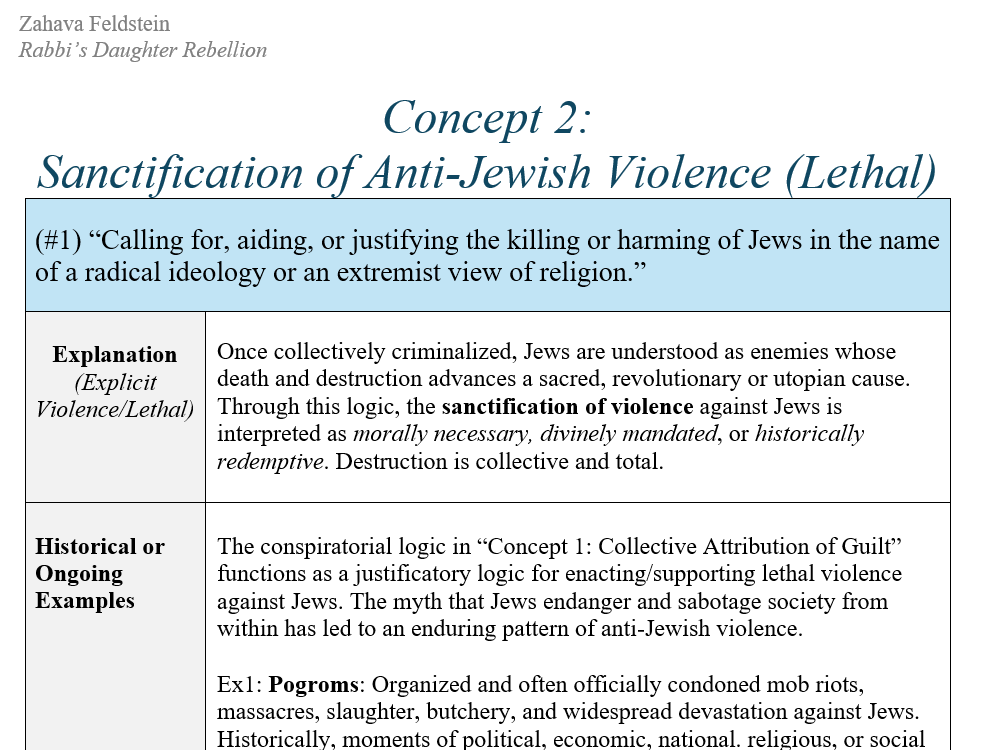
The tables attached below categorize IHRA’s eleven examples into seven categories. This document provides extensive educational infrastructure to make sense of the claims inside IHRA through historical events, ideological transformations, social movements, and present circumstances.
This document is supplemental — this document is educational.

The contemporary case studies referenced in these tables will be spotlighted and analyzed throughout the series over the coming weeks.
Concept Tables 1-3 will reappear most frequently in “repackaged” form through ostensibly social justice, anti-racist, and anti-colonial language and conduct. These tables include:
Concept 1: Collective Attribution of Crimes
Concept 2: Sanctification of Anti-Jewish Violence (Lethal)
Concept 3: Conspiracy Myth (The Organizing Fantasy)
While I have provided “examples” for each of IHRA’s seven categories of antisemitism, I do not adjudicate the limits of Concept Tables 4, 6, or 7. Examples are provided primarily as educational scaffolding, not implicit or decontextualized endorsement.
PREVIEW
So why do we need the JDA?
Because IHRA does not address how antisemitism is operationalized …
… Through credibility, legitimacy, and institutional judgment. IHRA does not name that Jews are required to perform ideological disavowal in order to be treated as legitimate participants in academic or social life.
For that, we turn to the JDA.
(2)
Jerusalem Declaration on Antisemitism
“Antisemitism is discrimination, prejudice, hostility or violence against Jews as Jews (or Jewish institutions as Jewish).”
Many Jews, especially on campuses, encounter an implicit but enforceable test: public denunciation of Zionism as a prerequisite for credibility, safety, or belonging. Crucially, this mechanism allows antisemitism to persist even when IHRA’s examples are nominally rejected — because one can insist that they only oppose ‘those’ Jews, the ones who fail the litmus test (i.e., “Zionists”).
See “The (Anti)Zionist Litmus Test” Process Model
The JDA was created through “an initiative” supported by a “number international scholars working in Antisemitism Studies and related fields, including Jewish, Holocaust, Israel, Palestine, and Middle East Studies.” Its authors present their motivation explicitly as reactionary to IHRA:
“The Jerusalem Declaration on Antisemitism responds to ‘the IHRA Definition’ … Because the IHRA Definition is unclear in key respects and widely open to different interpretations, it has caused confusion and generated controversy, hence weakening the fight against antisemitism. Noting that it calls itself ‘a working definition,’ we have sought to improve on it…”
The JDA approach reflects an ostensible commitment to academic freedom and proportionality. The document preserves an incredible amount of space for critique of Zionism/the State of Israel ideologically, politically, conceptually, and legally — without calling it “inherently” antisemitic.
The JDA explicitly acknowledges that antisemitism may appear in indirect or coded form and that identifying such cases requires contextual judgment. But the document contends that many forms of anti-Israel expression are “not antisemitic in themselves,” including:
· “opposing Zionism as a form of nationalism”
· “between the river to the sea”
· “point[ing] out systematic racial discrimination”
· “compar[ing]” Israel to “settler-colonialism or apartheid”
· Boycott, divestment, and sanctions (BDS)
Notably, “not antisemitic in themselves” does not mean never antisemitic.
“Context can include the intention behind an utterance, or a pattern of speech over time, or even the identity of the speaker, especially when the subject is Israel or Zionism. So, for example, hostility to Israel could be an expression of an antisemitic animus, or it could be a reaction to a human rights violation, or it could be the emotion that a Palestinian person feels on account of their experience at the hands of the State. In short, judgement and sensitivity are needed in applying these guidelines to concrete situations.”
Unfortunately, JDA foregrounds context and judgment without proactively providing a sustained mechanism to judge context coherently. In this sense, JDA’s claims ALSO cannot account for the suspension of belief in Jewish testimony before adjudication even begins.
To read the main claims of JDA through my analysis, please review the PDF attached here.
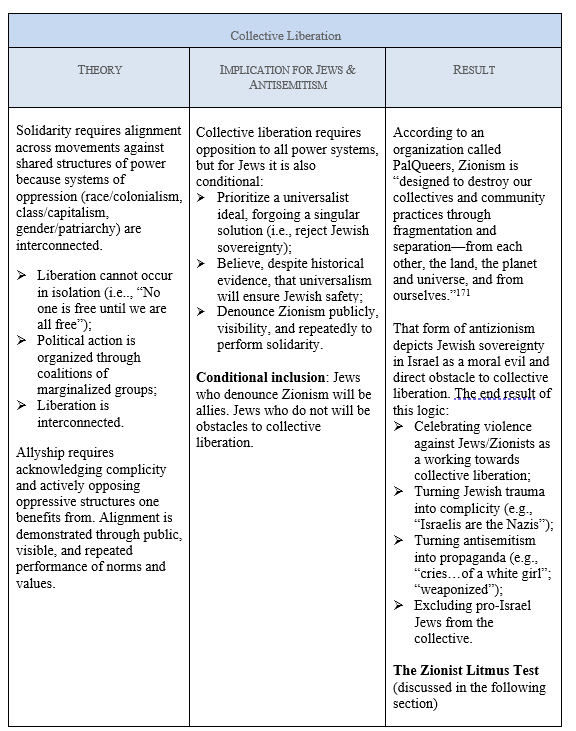
To consult the JDA in its direct form, visit their website.
JDA is, in many respects, idealistic. It identifies a form of anti-Zionism that can oppose the need for a sovereign Jewish state, employ highly critical legal, historical, and theoretical frameworks — including occupation, settler colonialism, imperialism, apartheid, and nationalism — and nevertheless avoid antisemitism in intent, application, and imagination.
But antizionist frameworks, especially those grounded in anti-colonial analysis, often move beyond legitimate criticism and embed classical antisemitic tropes into the rationales for collective ideology — even if unintentionally. For instance, JDA asserts, in Guideline #2 that, “the idea that Jews are linked to the forces of evil … stands at the core of many anti-Jewish fantasies.” When JDA later offers that “Applying the symbols, images and negative stereotypes of classical antisemitism … to the State of Israel” is antisemitic, they add “(see guidelines 2 and 3).” But JDA does not explicitly call Holocaust inversion antisemitic (e.g., calling Israelis “Nazis”) — so the connecting tissue to answer Is Holocaust inversion covered in guideline #2? is too frail.
JDA describes antisemitic “words, visuals, actions or conduct,” such as attacking a synagogue, but it does not directly address how to interpret situations where synagogues are targeted ‘because they are Zionist.’ The definition calls assaults directed at individuals “because she or he is Jewish” antisemitic, but what about when those Jews are wearing visibly pro-Israel symbols?
Alongside this lacuna, JDA explicitly leaves interpretive discretion based on “judgement” and “context” to the reviewer: “taking account of these guidelines.”
I see the vision; as someone who has lived in and thought through those spaces, I would love to believe that an “opposition to Zionism as a national project” that does not also engage classical antisemitic tropes of collective attribution of guilt, fantasy organizing logic, or the sanctification of anti-Jewish violence is a dominant form of anti-Israel logic in the U.S. That reality would have kept me a little more whole — but it is not the case as I lived it. I lived in this logic; and, eventually, it made me hate my heritage, my community, and my affiliations. It made me believe the destruction of Zionism was necessary for the liberation of the collective.
The JDA is missing the crucial guardrails to the keep its own logic safe.
In my view, the JDA insufficiently accounts for the sanctification of anti-Jewish violence as morally necessary, historically redemptive, or revolutionary inside prevailing antizionist discourses. These ideas are especially transferable to analyses rooted in race and power frameworks — particularly portrayals of Zionists as uniquely malignant or globally corrosive forces.
The JDA does not fully reckon with how normalized antizionist coercion has become. “Resistance by any means necessary” to Zionism prominently entangles Palestinian liberation through grandiose ideas about the historical redemptive-ness of dismantling Zionism, or the utopian fantasy of collective liberation.
If the only answer that reliably grants Jewish safety, credibility, or belonging in social justice or “collective liberation” communities is the sustained disavowal of Jewish sovereignty — not just of Israeli policies but a complete rejection of Zionism, Zionists organizations, family members, and the existence of the State of Israel — then we have to acknowledge that the denial of Jewish epistemic agency is a form of antisemitism.
This is where JDA offers the best contribution — not perfect, but closer than IHRA:
B. Israel and Palestine: examples that, on the face of it, are antisemitic
Requiring people, because they are Jewish, publicly to condemn Israel or Zionism (for example, at a political meeting).
Among the first question many (especially young) American Jews are asked, once their Jewish identity is revealed, is some version of: “Are you a Zionist?” This question functions as a litmus test.
Because I have followed up. I have asked: “What do you mean by Zionism?” And the response is consistent: “Do you support genocide!?”
Requiring Jews, simply because they are Jewish, to publicly denounce Israel or Zionism in order to be accepted, safe, or respected — with a pre-defined, reductionist definition of Zionism — is antisemitic.
Inside Jewish intellectual, cultural, and spiritual history itself, Zionism names a heterogeneous and internally contested set of traditions, aspirations, arguments, and historical responses. Zionism has carried multiple meanings across different historical, political, religious, and cultural contexts, and Zionism cannot be reduced to a single political formulation or moral category.
The question and its motives are the predictable result of intellectual, activist, and moral frameworks that demand ideological conformity, flatten complex histories and identities, and refuse to see Jews as vulnerable subjects inside (not above) complex systems.
But why are Jews uniquely required to pass a litmus test in the first place?
For that, we turn to the Nexus Document.
(3)
Nexus Document
“Antisemitism consists of anti-Jewish beliefs, attitudes, actions or systemic conditions. It includes negative beliefs and feelings about Jews, hostile behavior directed against Jews (because they are Jews), and conditions that discriminate against Jews and significantly impede their ability to participate as equals in political, religious, cultural, economic, or social life […] As an embodiment of collective Jewish organization and action, Israel is a magnet for and a target of antisemitic behavior. Thus, it is important for Jews and their allies to understand what is and what is not antisemitic in relation to Israel.”
The Nexus Document is often presented as a middle ground and, in many respects, it succeeds. The Nexus Project aims to combat antisemitism while upholding “pluralistic democracy.” The organization “engages with American civic and political leaders, schools, and decision-makers to fight antisemitism and protect democratic freedoms, including free speech.” The Nexus Project makes two novel contributions.
First, Nexus operationalizes the foundational legitimacy of Jewish testimony credibility:
What Is Antisemitic?
All claims of antisemitism made by Jews, like all claims of discrimination and oppression in general, should be given serious attention.
Second, Nexus defines the ideological function of antisemitism, not merely the components of hatred and conspiracy in antisemitic ideology. Nexus explains how the moral inversion occurs; why Jews are treated not as a minority navigating dominant systems, but as the secret force animating them.
“Antisemitism fulfils a social function: It provides an explanation for social disorders. People use it to demonize and fuel the oppression of any minority and all minorities, while fomenting division between Jews and other minorities. As the embodiment/realization of collective Jewish organization and action, Israel is a magnet for and a target of antisemitic behavior.”
Antisemitism is a social code that directs negative sentiment (i.e., anger, frustration) toward Jews. This is not an unprecedented claim, nor is it unimaginable that Israel would become a “magnet” for such sentiment.
Thinking historically, pogroms across the Russian empire were often compelled by a similar logic: target Jews as landowners, beneficiaries, capitalists ‘at my expense.’ The regime often state-sponsored these attacks — which redirected their own fault onto Jews. In this sense, antisemitism provides an explanatory shortcut to redirect anger away from complex systems onto a more singular target. It may compel people who feel stifled in society to confront states, empires, corporations, or political elites through Jewish targets.
This displacement appears repeatedly in antizionist discourse. A Gaza campus encampment demand that “No Zionists” can be involved in “determining where our tuition money is going - removal [of] individuals with ties to Israel from Board of Trustees.” A BIPOC Columbia student arguing, “white Jewish people are today and always have been the oppressors of all brown people.” A graduate faculty member who “extensively discussed, by name, Jewish donors” and “called these Jewish men ‘wealthy white capitalists; who ‘laundered’ ‘dirty money’ and ‘blood money.’
Coded antisemitic accusation often fulfills the social function because it recasts Jews — through Zionism — not as subjects harmed by powerful systems, but as architects complicit in maintaining oppressive systems (e.g., “no one cares how much a white girl cries anti-semitism when we say stop the genocide”).
This story says Jews are not victims like other groups, but active supporters and beneficiaries of the very structures that oppress other groups. This belief can easily grow into an ideologically that presumes Jews protect systemic oppression.
For me, I became a central object onto which my classmates’ anticolonial rage was concentrated, transforming what perhaps could have been legitimate political critique into targeted bullying, the coercive demand that I celebrate Jewish death, and the suspension of my testimony as credible — at the moment when I pushed back to say, “actually, you’re missing some facts.”
During a graduate seminar, one classmate argued — out of nowhere — that Israel was oppressing Palestinian children by withdrawing funding from UNWRA. I corrected that the State of Israel does not fund UNWRA. In her self-righteous response, she corrected that Israel had used their narrative power over Western governments to compel UN member states to withdraw funding from UNRWA as part of the broader Zionist war strategy. While member states that suspended funding had done so at that point following legitimate allegations that some of UNRWA’s employees participated on October 7th, my classmate imagined the Israeli government not as one political actor among many, but as a manipulative agent pulling the strings of geopolitical powers.
This logic reproduces a classical antisemitic structure in which Jews are imagined not merely as participants within systems of power, but as power itself: a uniquely malevolent force held collectively culpable for global injustice. Once Zionism is framed as the organizing force behind colonialism, racial capitalism, white supremacy, and global oppression, the transition into conspiratorial thinking becomes remarkably easy.
Nexus offers precision when sketching between Israel, Zionism, antisemitism, and free speech (e.g., legitimate political speech). The following table emphasizes this analytical specificity and intentionality. These following are direct quotes from the Nexus Document definition, although I have modified the order of presentation.
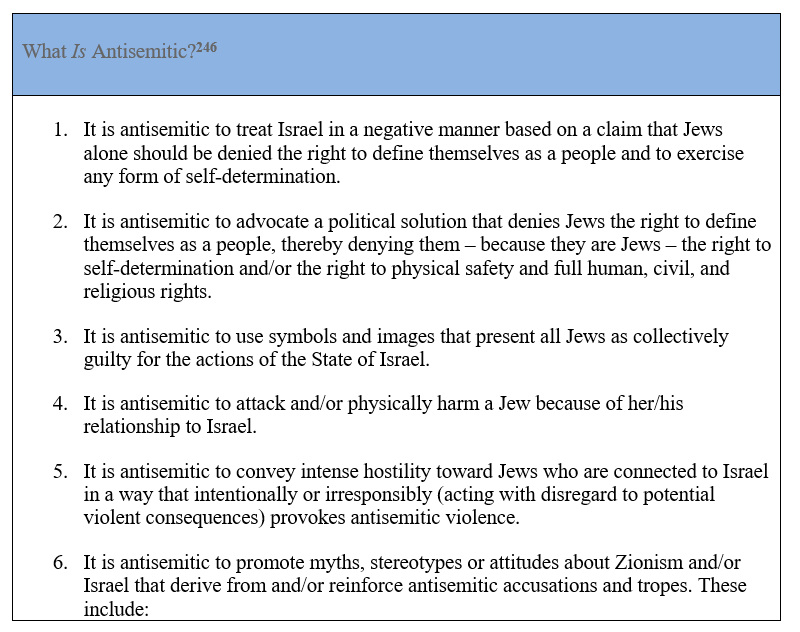
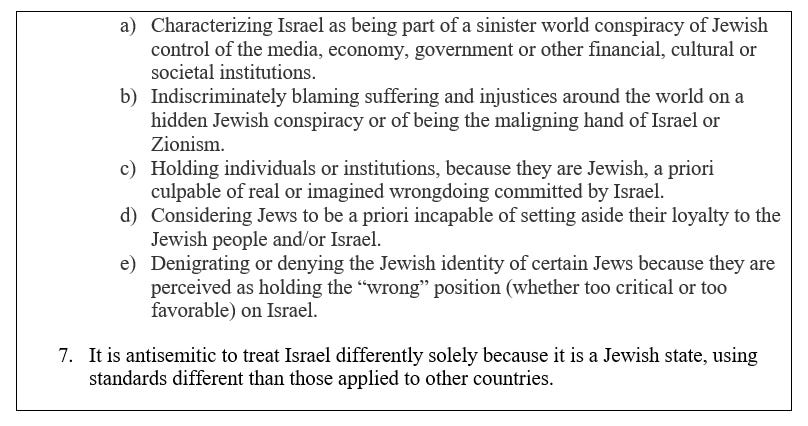
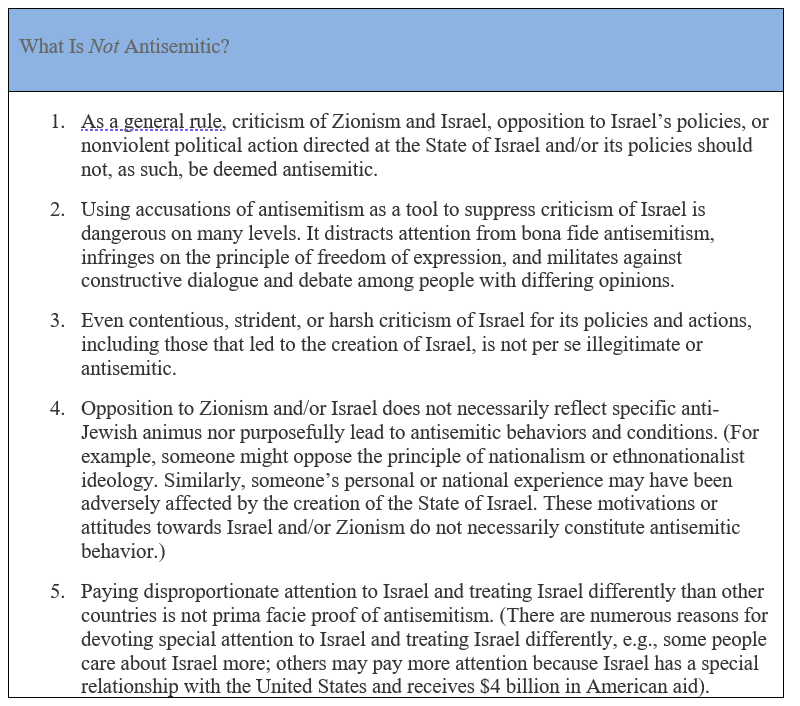
But again, same as with IHRA and JDA, the impact of Nexus foundationally depends on interpretive discretion.
Nexus does clarify, “The definition is designed as a guide for policymakers and community leaders as they grapple with the complexities at the intersection of Israel and antisemitism.”
The three proposals for defining antisemitism discussed in this issue of Coded De-Coded — IHRA, JDA, and Nexus — provide distinct insights into how contemporary “lefty” antisemitism is operating.
But all three were initially conceived before October 7, 2023.
While each addresses components of “coded antisemitism,” they are nonspecific to the present epistemic reality. Even that act of putting them in conversation, while it paves new directions, cannot resolve the pragmatic institutional problem: the real-life experiences of these mechanisms remain subject to interpretive discretion.
Definitions alone cannot resolve the interpretive problems surrounding contemporary antisemitism because the same rhetoric can appear to one audience as anti-racist, anti-colonial, and emancipatory while also reproducing antisemitic structures — “classical” or “repackaged.”
The purpose of this series is therefore not to force allegiance to one definition over another, but to examine the mechanisms through which antisemitic logic mutates, stabilizes, and becomes institutionally intelligible in contemporary activist and academic life beyond definitional allegiance.
Beginning next week, “Coded” De-Coded will move into case studies. We will begin examining how coded antisemitism operates: through protest slogans, institutional statements, classroom discourse, activist rhetoric, and campus controversies — specifically cases where antisemitic structures are articulated through the moral vocabularies of justice, anti-racism, decolonization, and collective liberation.