
“Coded” De-Coded: How Lefty Antisemitism Works
A Toolkit Series | The MIT Complaint & Title VI "Gap" for Jewish Students | A public interpretive toolkit for recognizing how antisemitic logic mutates, disguises itself, and becomes morally legible

“Coded” De-Coded: How Lefty Antisemitism Works is a multi-issue public interpretive toolkit examining how antisemitic ideas mutate, disguise themselves, and become morally legible within contemporary activist, academic, and institutional language.
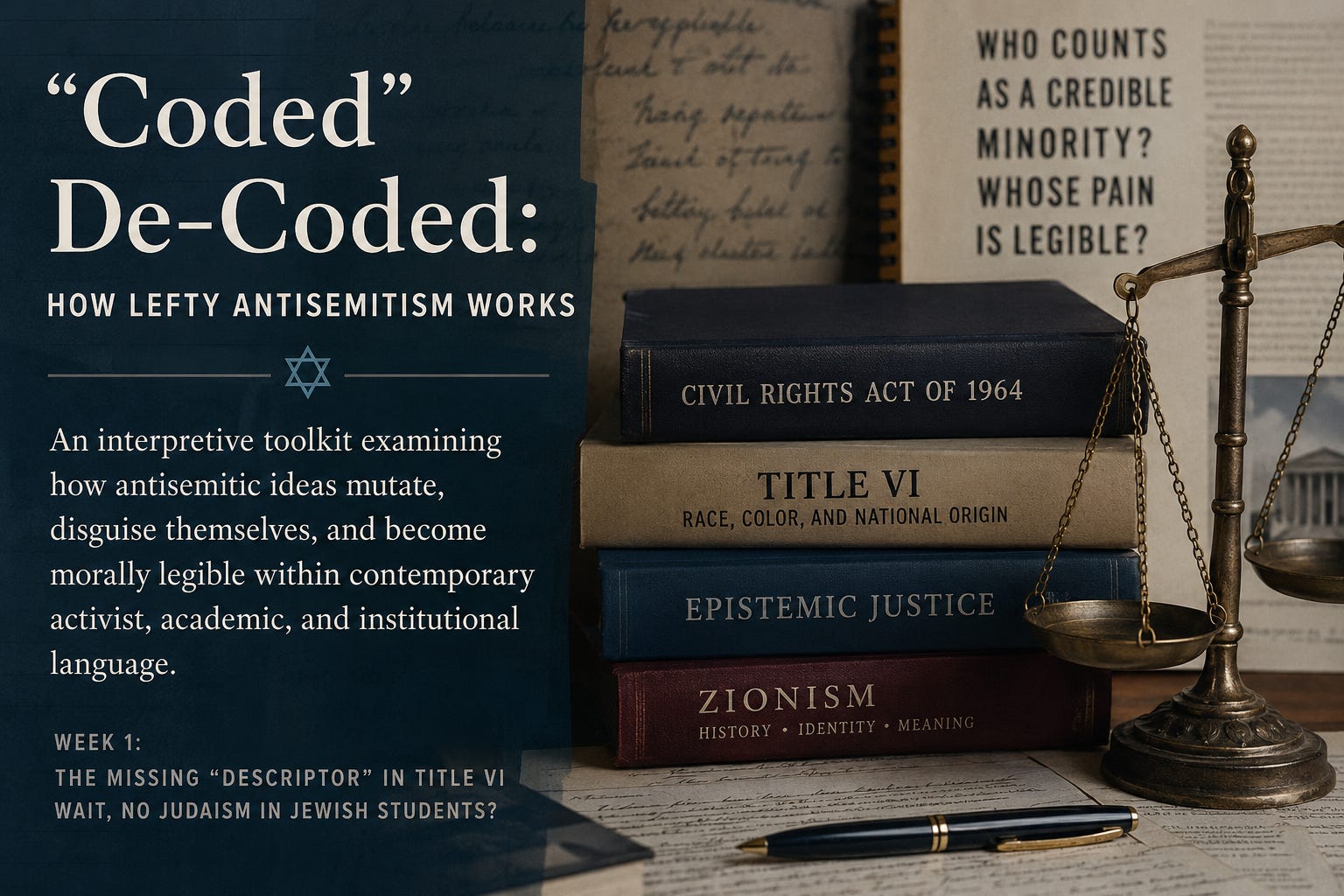
This series was developed out of the realization that in public fights over how to “define” antisemitism, many of the loudest voices cannot coherently articulate their position. Zionism is not simply “the right of a Jewish state to exist.” Zionism is not simply “genocide.” Both reductive praise and reductive condemnation oversimplify Zionism.
Inside Jewish intellectual, cultural, and spiritual history itself, Zionism names a heterogeneous and internally contested set of traditions, aspirations, arguments, and historical responses. Zionism has carried multiple meanings across different historical, political, religious, and cultural contexts, and Zionism cannot be reduced to a single political formulation or moral category.
Contemporary debates over antisemitism increasingly hinge on competing understandings of Zionism itself — which is partly why I am creating this toolkit.
A product of research, lived experience, and a deep investment in pedagogy, each issue of “Coded” De-Coded takes one concrete anti-Israel example — a campus incident, institutional statement, protest slogan, classroom controversy, legal dispute, or public controversy — and unpacks the interpretive mechanics beneath the logic. Together, we will examine moments when antisemitic sentiment operates, mutates, and becomes legible within contemporary activist, academic, and institutional discourse.
This first issue of “Coded” De-Coded begins with a legal challenge: Title VI law.
Today is the prequel.
This series is informed by my own experience, too. I have been on both polarized sides of this debate — day school kid turned JVP who after 10/7 climbed back to Sinai inch by inch — I know the demand to celebrate Jewish death to “prove” my solidarity to classmates. I also know the heartbreak I felt when I came back to Jewish life, begging community organizations to support my fight against my own university’s antisemitism, and received the ultimatum: pledge to IHRA, or “no, we won’t help you.” At the time, as a doctoral student studying how “activist-intellectual” frameworks think about Jews and Jewish experience — being forced to dilute years of deep synthesizing into a slogan felt especially depressing.
And this is what I was coming back from…This litmus test.
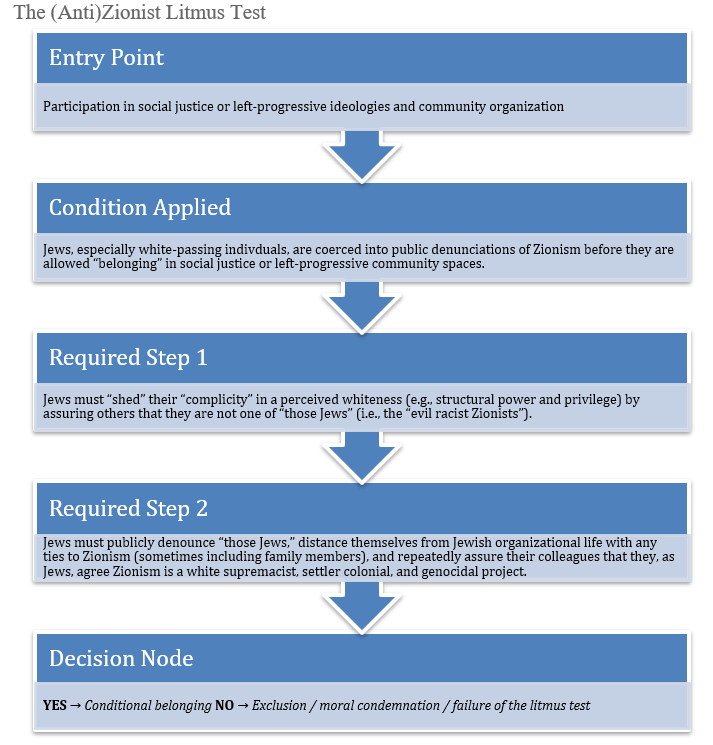
The goal of “Coded De-Coded” is to build a practical public toolkit for recognizing when classical antisemitic structures reappear in contemporary moral vocabularies — moving beyond vague definitional allusions toward a clearer understanding of what activist-intellectual frameworks actually say, how they function in practice, and where their interpretive limits emerge for Jews, Israel, and Zionism.
Welcome to Week 1.
The Missing “Descriptor” in Title VI:
Wait, No Judaism in Jewish Students?
In March 2024, the StandWithUs Center for Legal Justice submitted a 71-page Title VI complaint against the Massachusetts Institute of Technology (MIT). The Jewish advocacy organization — supporting Jewish students — characterized Jews as a collective, Indigenous to the Land of Israel, who hold “a historical bond, along with the Jewish people’s right to self-determination in their ancestral homeland.” Their complaint argued that Zionism is “the foundation of Jewish identity.” They cited IHRA. And they lost.
The way U.S. civil rights law is written requires Jewish students to be framed as a group with “shared ethnic characteristics” and/or “national origin”—not religion. The foundational ideas of political Zionism arguably fit that criteria:
Indigeneity
Shared origin
Peoplehood
National consciousness
Tribal inheritance
Exile, Diaspora, Return
So why didn’t it work?
The Civil Rights Act of 1964:
Missing Descriptor in Title VI
When Lyndon B. Johnson signed the Civil Rights Act of 1964, the decision was widely described at the time as “the most sweeping civil rights legislation since Reconstruction.” But the landmark Civil Rights Act did not establish a single, universal prohibition against all forms of discrimination. Instead, it created distinct legal protections that vary by institutional context. Different titles of the Act govern different domains — public accommodations, employment, federally funded programs.
The Civil Rights Act of 1964 protected “religion” in employment (Title VII) and public accommodations (Title II), but not in federally funded programs, such as colleges and universities (Title VI).
Further specified:
Title VII (employment) covers: “race, color, religion, sex, or national origin”
Title II (public accommodations) covers: “race, color, religion, or national origin”
Title VI only covers: “race, color, and national origin”
This domain-distinct wording complicates protections for Jewish students, who are not protected against discrimination as a religious group.
In the past decades, the federal government has offered ostensible remedies. According to a September 2004 letter from the Department of Education, Office for Civil Rights, Jews can be protected under Title VI so long as:
Groups that face discrimination on the basis of shared ethnic characteristics may not be denied the protection of our civil rights laws on the ground that they also share a common faith [...] OCR will exercise its jurisdiction to enforce the Title VI prohibition against national origin discrimination, regardless of whether the groups targeted for discrimination also exhibit religious characteristics. Thus, for example, OCR aggressively investigates alleged race or ethnic harassment against Arab Muslim, Sikh, and Jewish students.
This statement clarified that while Jewish students are not protected under Title VI on the basis of a shared religious identity, when considered as a group with shared ethnic characteristics or national origin they may qualify.
The MIT complaint should have succeeded by classifying Jews under the parameters established by the federal government. However, even as StandWithUs exerted considerable word count establishing “that Zionism cannot be separated from the identity of most Jews,” depicting Jews as an ethnic group with shared national origins through Zionism, the court precluded recognition before fact-finding began.
In this double-edged sword:
U.S. civil rights law ostensibly includes Jews as a group with “shared ancestry” and “national identity” — core tenants of Zionism — while those responsible for adjudicating Title VI protections can simultaneously reject the legitimacy of shared Jewish ancestry and Indigeneity — core tenants of antizionism. According to a statement by Circuit Judge Willian Kayatta upon denying a StandWithUs appeal:
“Little of what occurred can be deemed antisemitic merely because plaintiffs declare it to be so.”
Were Jews just…not believed?
Civil Rights Law & Its Zionism Problem
In a February 2026 op-ed for Tablet Magazine, civil rights lawyer Matthew Segal argued that the MIT decision “just carved Jews out of civil rights law.” Naming this phenomenon “the anti-Zionist exception,” Segal contends that “Civil rights law has an anti-Zionism problem” because:
“In cases alleging discrimination, courts typically allow civil rights plaintiffs to use a contextual test—assessing what the U.S. Supreme Court has called the “totality of the relevant facts”—to prove that discrimination in fact occurred. And when key facts are disputed, courts rely on juries to resolve them. Juries are quintessential finders of fact, and discrimination is a quintessential fact question.”
The court effectively treated antizionism as non-discriminatory, rather than as a phenomenon whose meaning depends on context. Other protected group do not bear a comparable burden of establishing that the discrimination they experienced “counts” as discrimination before fact-finding.
How did this happen?
Disbelieving Jewish Testimony
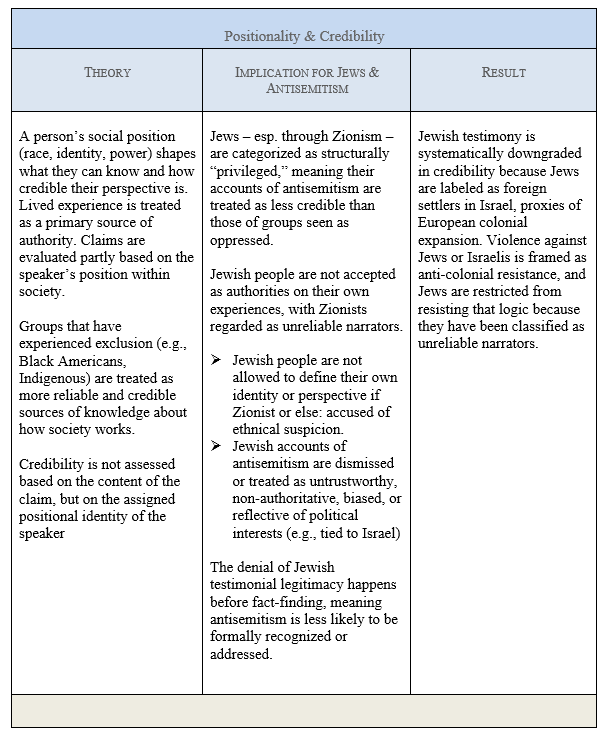
Knowledge is not neutral or universal, but situated. That’s what I was taught as an American Studies major at Scripps College. Meaning is produced through one’s specific social location, historical inheritance, and cultural or religious traditions. The different identities that make up a person—religious, racial, linguistic, cultural—shape how we interpret the world and make meaning within it. The logic follows: peoples positioned as marginal or nondominant within Western society possess moral and analytic authority derived from their experiences of exclusion, subordination, and structural disadvantage.
This idea draws heavily from theorists like Michel Foucault. Edward Said’s Orientalism, as well, argued that knowledge production itself operates as a site of domination: shaping collective understanding by privileging certain narratives while omitting, distorting, or overwriting others. Said’s work as well is often cited as evidence that epistemology is inseparable from power, and that meaning-making processes are embedded in historical relations of dominance.
The issue, as I see it, is that under contemporary critical theory paradigms, especially postcolonial theory, Jews are not included as among “marginal or nondominant” groups in Western society.
[The conspiratorial attribution of “knowledge production” power to Jews is a lesson for another time — one that, ironically, has far more to do with interpreting Holocaust memory, because it happened “in Europe,” as symbolizing Jewish narrative control over Western canon, than it does deserving sympathy for the victims and survivors of Nazi genocide. But that’s for a later issue.]
The primary concern at stake now is Jews denied the credibility of their positionality, their “status” as credible narrators of their own experiences — in an American court of law.
Recall Judge Kayatta’s opinion, that “Little of what occurred can be deemed antisemitic merely because plaintiffs declare it to be so.”
Epistemology refers to the idea that different people and communities possess distinct “ways of knowing” which are shaped by inheritance, language, economic status, social position, history, culture, and other forms of identity. Positionality builds on epistemology by describing how an individual’s social location can inform their perceptions of reality.
Positionality and epistemology explain why multiple individuals may interpret the same event differently. To deny an individual group’s epistemology constitutes testimonial injustice.
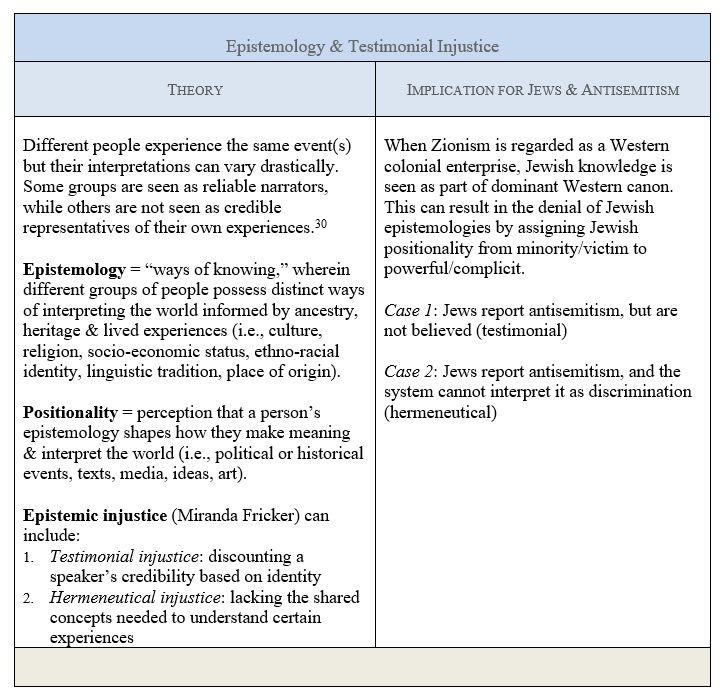
Epistemic injustice occurs, however, when a person knows something about their own experience or reality, yet the system charged with evaluating their experience fails to register their knowledge as legitimate.
Originating in the work of Miranda Fricker, epistemic injustice proposes that systems of authority, evaluation, and interpretation do not merely err in assessing particular claims: they actively discount, misread, or render unintelligible the testimony of certain speakers based on identity, social position, or perceived credibility.
Institutional actors (“in adjudicatory power”) can ignore the testimony of Jewish subjects by forcing Jewish testimony through an external, pre-determined interpretive frameworks that deny credibility before fact-finding, deciding, essentially: “Sounds like a you problem.”
What interests me is not simply whether antisemitism exists on the political left. Of course it does. The more difficult question is how it hides— how certain antisemitic conspiracy ideas become morally legible, institutionally defensible, and socially intelligible within contemporary activist, academic, and public language.
That is the project of “Coded” De-Coded.
Today was a prelude — setting up the stage. Next, each issue will take on concrete examples — a campus incident, institutional statement, protest slogan, classroom controversy, or public argument — and slow it down to examine the interpretive mechanics underneath. Not just what is being said, but what assumptions, frameworks, and moral logics make particular claims appear persuasive, reasonable, or even righteous to the people advancing them — even as they repackage classical antisemitic tropes.
The MIT Title VI case offers an important starting point because it lets us ask: who counts as a credible minority? Whose pain is legible?
It seems to me that if Jewish testimony is being treated as subjective perception rather than as evidentiary knowledge, then we are refusing Jewish people the foundational right to define themselves through their own ideas and creative acts. A right prioritized under DEI logic for every other marginalized community. That tension does not stay confined to courtrooms.
Over the coming weeks, this series will move through those layers to decipher where, how, and why frameworks about power and privilege (e.g., anti-racism, anti-colonialism) are unable to recognize anti-Jewish discrimination accurately because their interpretive machinery is not built to recognize antisemitism inside its own categories. Shaping, as a result, not only how antisemitism is discussed in classrooms, but how institutional actors—faculty, administrators, compliance offices, and judges—classify incident reports, assess credibility, and determine appropriate responses.
The concern is not whether collective liberation frameworks are internally coherent or morally persuasive in the abstract; trust me, they are. The threat is decontextualized applications of social justice pedagogy that deny Zionist Jews the right to narrate their own experiences.
Interpretation is never neutral.
If Jews are understood primarily through narratives of whiteness, privilege, colonialism, state influence, and narrative power — Jewish testimony about antisemitism will remain unintelligible before adjudication even begins.
“Coded” De-Coded exists to examine this directly. Exactly because contemporary critical theory characteristically foregrounds positionality, situated knowledge, and epistemological self-reflexivity, I plan to critique critical theory as a Jewish critical theorist while explicitly naming Jewish epistemology, Jewish historical situatedness, and Jewish interpretive inheritance as legitimate sources of knowledge production.
Next week, we turn to the definitions everybody fights — IHRA, JDA, Nexus — …none will win. But you will definitely learn.
The next issue offers pedagogical starting ground: a side-by-side, honest, and rigorous comparison.
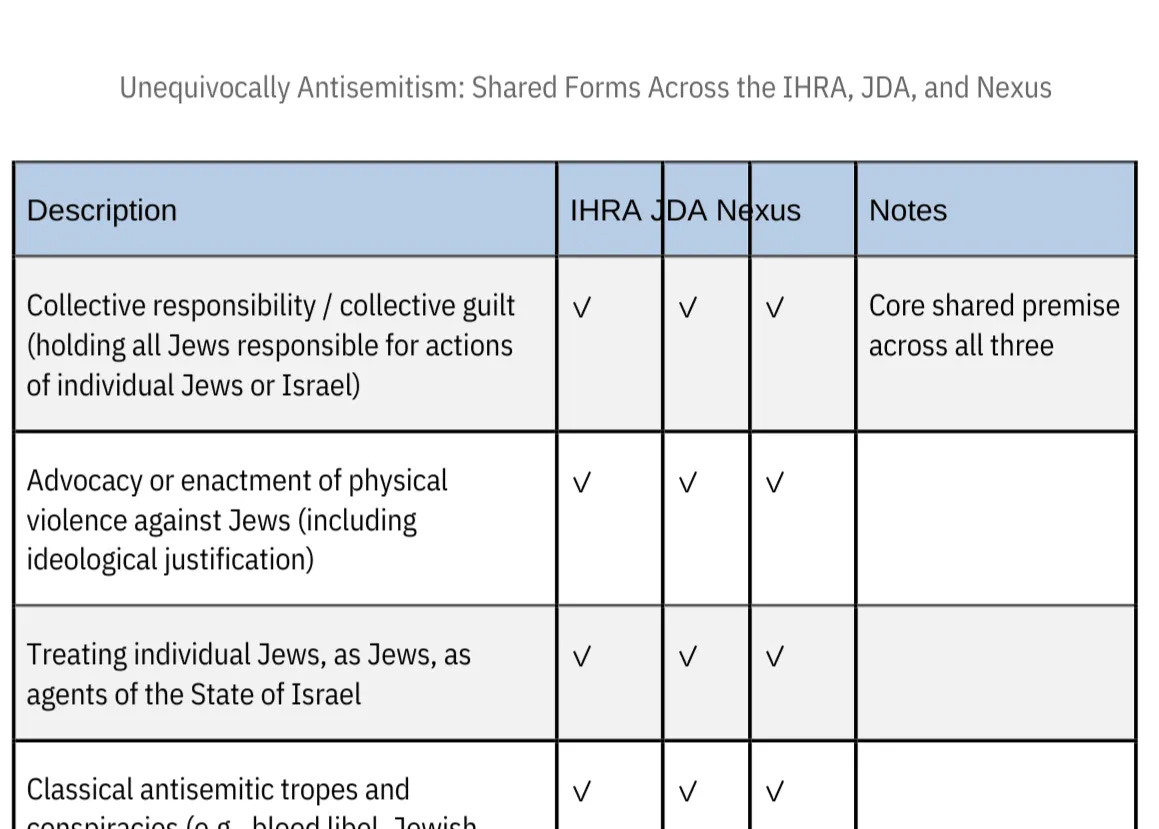
Rather than treating allegiance to any of one these definitions as slogans in a political fight, over the coming weeks I will map what they actually say, where they agree, where they diverge, and what each one helps readers see that the others do not. This series does not claim a stake in any one definition. Instead, I will showcase that we need tools from all three definition to explain the dynamics as they are playing out on the left— and especially on campuses.
And then, we’ll encounter the case of the Columbia student who wrote, “white Jewish people are today and always have been the oppressors of all brown people” — before graduating with a “Multicultural Cord” awarded for “an outstanding commitment to diversity, social justice, and multiculturalism through … campus leadership … and personal dedication.”
Perfect article (and articles to come) at the time most needed. I look forward to the next post in this series.